
Choosing an industrial boiler from a single capacity figure is rarely enough. A factory may require a high output for thirty minutes during startup, a moderate load through most of the production shift and only a small load at night. These operating conditions cannot be represented accurately by one average number.
An industrial boiler load profile records how steam or heat demand changes over time. It shows the minimum, normal and peak demand, the duration of each condition, the timing of batch processes and the loads that operate simultaneously. This information helps engineers compare one large boiler with multiple smaller boilers, evaluate turndown and sequencing, and avoid both insufficient capacity and unnecessary oversizing.
This guide follows our practical industrial boiler sizing guide and explains how to turn process information into a load profile that a boiler supplier can review.
Quick Answer
To create an industrial boiler load profile, list every steam or heat user and record its minimum, normal, maximum and startup demand. Add the time of operation, batch duration and whether it runs at the same time as other users. Plot the realistic simultaneous demand by hour or production step, then identify the minimum continuous load, normal operating band, short-duration peaks and maximum sustained demand. Use verified measurements when available and mark estimates separately. Final boiler selection must also confirm pressure or temperature, fuel, feedwater, site conditions, redundancy and future expansion.
Key Takeaways
- Average daily consumption is not a reliable boiler-sizing basis by itself.
- Connected load and simultaneous load are different.
- Minimum load matters because an oversized boiler may cycle frequently at low demand.
- Peak magnitude, duration and frequency should all be recorded.
- Startup, cleaning and sterilization loads should be separated from normal production.
- Existing factories should use meter trends and operating records whenever possible.
- New factories should build a time-based schedule from equipment data and production cycles.
- Multiple boilers may provide better load coverage, but the final arrangement requires technical review.
- Illustrative calculations must not be treated as final Anton Boiler model data.
Table of Contents
- What is an industrial boiler load profile?
- Why average demand is not enough
- Minimum, normal, peak and startup demand
- How to collect load data in an existing factory
- How to estimate demand for a new factory
- Connected load versus simultaneous load
- Illustrative daily steam-load schedule
- Peak duration and frequency
- Minimum load and operating range
- Steam and hot-water load profiles
- One large boiler or multiple boilers?
- Future expansion and design allowances
- Common load-profile mistakes
- Information to send to a boiler supplier
- Frequently asked questions
1. What Is an Industrial Boiler Load Profile?
An industrial boiler load profile is a time-based record of the steam flow or heat duty required by a facility. It may cover a normal production day, a week, a season or several representative operating modes.
For a steam system, the vertical axis normally shows steam demand in kg/h, t/h or lb/h. For a hot-water or thermal-oil system, it normally shows heat duty in kW or MW. The horizontal axis shows time, production stage or batch sequence.
A useful profile should identify more than the highest point. It should show:
- Minimum stable demand
- Normal production range
- Maximum sustained demand
- Short-duration peak demand
- Startup and warm-up demand
- Shutdown and cleaning demand
- Shift, weekend and seasonal differences
- Confirmed future loads
The U.S. Department of Energy’s Steam System Survey Guide recommends profiling the steam system and evaluating operating characteristics as part of a system assessment. A load profile is therefore both a selection tool and an operating-management tool.
2. Why Average Demand Is Not Enough
Average consumption can hide important operating conditions.
Assume a factory uses 16 tonnes of steam during an eight-hour shift. Dividing 16 tonnes by eight hours gives an average of 2 t/h. That does not prove that a 2 t/h boiler is suitable.
The plant may require:
- 0.6 t/h during preparation
- 1.8 to 2.2 t/h during steady production
- 3.2 t/h for a forty-minute startup period
- 2.8 t/h when two batch users overlap
The average is useful for estimating total energy use, but the boiler plant must also respond to the actual operating range. Selecting only from the average could create a pressure drop during peaks. Selecting only from the highest short peak could produce unnecessary low-load cycling during most of the day.
The correct question is not simply, “What is the average demand?” It is, “How much demand occurs, for how long, how often and at what pressure or temperature?”
3. Minimum, Normal, Peak and Startup Demand
Minimum Demand
Minimum demand is the lowest sustained load that the system must serve while the boiler remains in operation. It may occur at night, between batches, during reduced production or when only tracing and building heating are active.
Record both the value and the duration. A very low demand lasting six hours has a different effect from a five-minute gap between two batches.
Normal Demand
Normal demand is the range in which the plant operates for most of its productive time. Use a band rather than one exact number whenever the process varies.
For example, a factory may normally operate between 1.7 and 2.1 t/h, rather than at exactly 1.9 t/h.
Peak Demand
Peak demand is the highest realistic simultaneous requirement. It should not be created by adding every equipment nameplate if those users never operate together.
Record:
- Peak flow or heat duty
- Duration
- Frequency
- Required pressure or temperature at the user
- Equipment creating the peak
- Whether production timing can be adjusted
Startup Demand
Startup demand includes warming cold equipment, pipework, vessels, water and process materials. It may be greater than the steady production load, but it may occur only once per shift or once per day.
Separating startup from normal demand allows the supplier to evaluate whether the peak should be covered by boiler capacity, stored energy, process scheduling or a multi-boiler arrangement.
4. How to Collect Load Data in an Existing Factory
Existing factories should begin with measured data whenever reliable instruments are available.
Useful sources include:
- Steam flowmeter trends
- Fuel-meter records
- Hot-water supply and return flow
- Supply and return temperatures
- Boiler control-system histories
- Header-pressure trends
- Production records
- Batch logs
- Shift reports
- Condensate-return records
Recommended Measurement Interval
Choose an interval that captures the process cycle. Hourly readings may be adequate for a steady plant, but they can hide a fifteen-minute sterilizer peak or rapid batch changes. For variable production, five-minute or fifteen-minute trends may be more useful.
Cross-Check the Data
Do not rely on one instrument without review. Compare steam flow against fuel use, production output, header pressure and operator records. Investigate missing values, instrument range limits and obvious calibration problems.
The Department of Energy’s steam tools and publications encourage measurement and trending of boiler and steam-system performance. Historical trends are especially valuable because they show how frequently each load condition actually occurs.
5. How to Estimate Demand for a New Factory
A new factory has no operating history, so the profile must be built from process information.
Create a table for every heat user with the following fields:
| Item | Required Data |
|---|---|
| Equipment | Name and process function |
| Heat medium | Steam, hot water or thermal oil |
| Demand | kg/h, t/h, kW or MW |
| Pressure/temperature | Required at the point of use |
| Startup demand | Initial warm-up requirement |
| Normal demand | Steady operating requirement |
| Batch duration | Minutes or hours per cycle |
| Starts per shift | Expected frequency |
| Timing | Planned start and stop time |
| Simultaneous operation | Which other users run at the same time |
| Data status | Confirmed, calculated or estimated |
Use equipment-manufacturer data when available. If demand must be calculated, record the calculation basis: mass, specific heat, temperature rise, evaporation duty, heating time and expected losses. Do not hide uncertain values inside a general safety factor.
6. Connected Load Versus Simultaneous Load
Connected load is the sum of every installed steam or heat user. Simultaneous load is the demand from the users that can realistically operate at the same time.
Suppose a plant contains four batch vessels, each requiring 500 kg/h during heating. The connected load is 2,000 kg/h. If the production schedule allows only two vessels to heat simultaneously, the batch contribution to the maximum simultaneous load may be 1,000 kg/h, subject to verification.
This distinction can materially affect boiler capacity. However, diversity should never be assumed without operational evidence. Ask the production manager whether operators can override the schedule, whether cleaning overlaps production and whether future shifts may change the sequence.
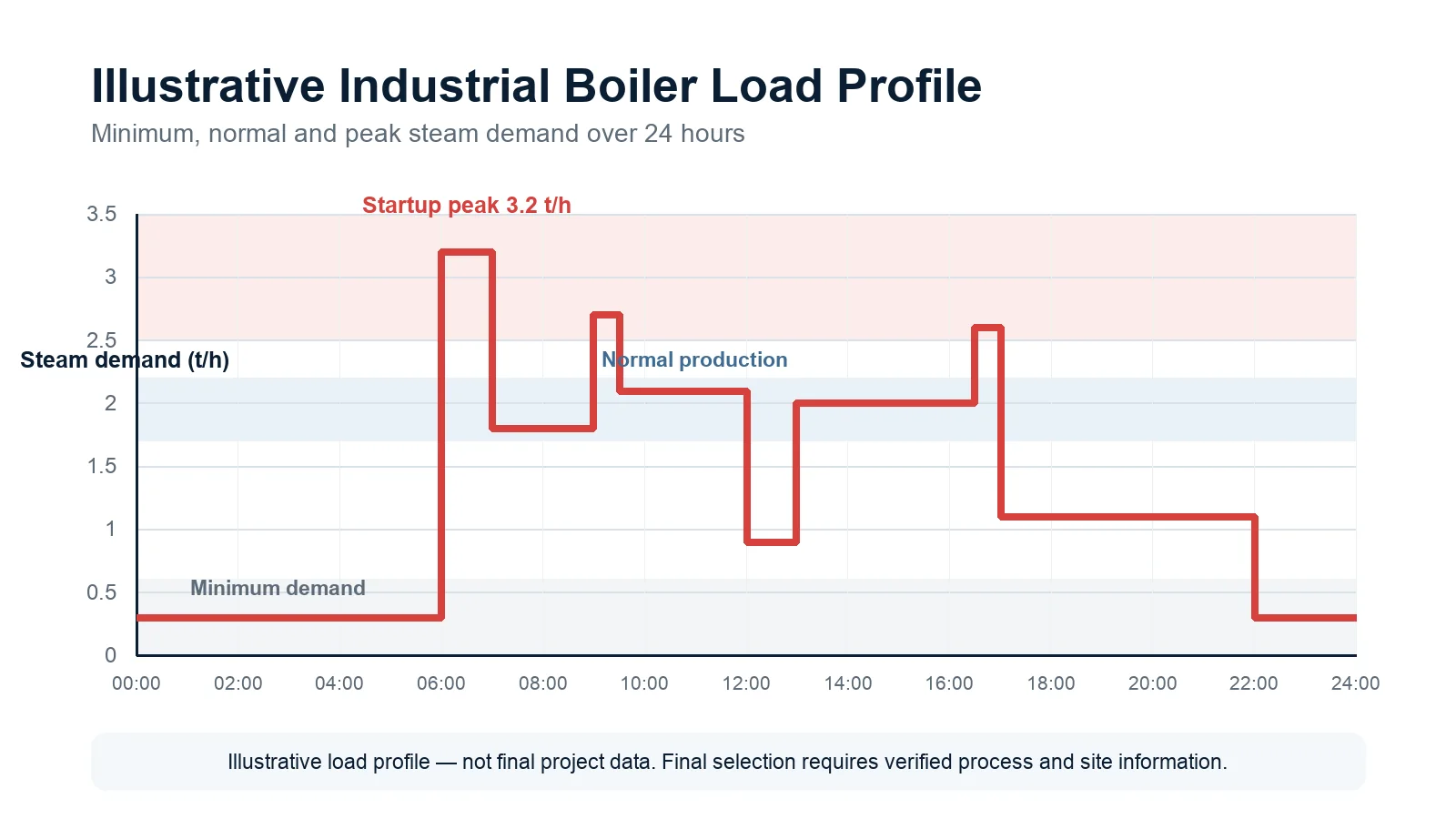
7. Illustrative Daily Steam-Load Schedule
The following table is an example only. It is not a final boiler selection and does not describe a specific Anton Boiler model.
| Time | Operating Condition | Steam Demand |
|---|---|---|
| 06:00–07:00 | Cold startup and line warm-up | 3.2 t/h |
| 07:00–09:00 | Production line A | 1.8 t/h |
| 09:00–09:30 | Lines A and B overlap | 2.7 t/h |
| 09:30–12:00 | Normal combined production | 2.1 t/h |
| 12:00–13:00 | Reduced production | 0.9 t/h |
| 13:00–16:30 | Normal combined production | 2.0 t/h |
| 16:30–17:00 | Cleaning peak | 2.6 t/h |
| 17:00–22:00 | Reduced second shift | 1.1 t/h |
| 22:00–06:00 | Tracing and standby users | 0.3 t/h |
From this illustrative schedule:
- Minimum sustained demand is approximately 0.3 t/h.
- Normal production demand is mainly 1.8 to 2.1 t/h.
- The highest short peak is 3.2 t/h.
- The operating range is much wider than the daily average suggests.
The final design would need to confirm the peak duration, recovery requirement, boiler operating range, steam pressure, distribution losses and whether the low overnight load should be served by the same boiler.
8. Peak Duration and Frequency
A peak is not defined by magnitude alone.
Compare these two conditions:
- 3.2 t/h for five minutes once per day
- 3.2 t/h for two hours three times per shift
They have the same peak flow but very different design implications.
For every peak, record:
- How long it lasts
- How often it occurs
- Whether it follows a low-load or high-load period
- Whether other equipment starts at the same time
- How much pressure variation the process can tolerate
- Whether the production schedule can be changed
Short, infrequent peaks may sometimes be addressed through stored thermal energy, a steam accumulator or process scheduling. Spirax Sarco’s technical guidance on steam accumulators explains how stored energy may support demand above boiler output under suitable conditions. Such solutions require project-specific engineering; they are not universal substitutes for capacity.
9. Minimum Load and Boiler Operating Range
The minimum demand helps determine whether the proposed boiler can operate steadily during low-load periods.
If the plant frequently requires much less heat than the boiler’s stable operating range, the boiler may cycle on and off. Frequent cycling can increase startup losses, create pressure variation and add wear to burners, controls and auxiliaries.
Do not assume a fixed turndown ratio for all boilers. The usable operating range depends on boiler design, burner type, fuel, control system and manufacturer limits. Ask the supplier to confirm in writing:
- Minimum continuous output
- Burner modulation range
- Start/stop control logic
- Expected operation at the recorded minimum load
- Recommended multi-boiler sequencing, if applicable
The DOE notes that load profile matters when purchasing efficient boilers and that low-load operation should be considered rather than evaluating peak demand alone.
10. Steam and Hot-Water Load Profiles
Steam Systems
For steam, record mass flow and the pressure required at the point of use. Also note:
- Boiler outlet pressure
- Header pressure
- Pressure-reducing stations
- Condensate-return percentage and temperature
- Feedwater temperature
- Blowdown and boiler-house steam consumption
- Steam quality requirements
- Distribution losses
Rapid steam-demand changes can affect header pressure and steam quality. The profile should therefore include both flow and pressure trends when available.
Hot-Water Systems
For hot water, record heat duty together with:
- Supply temperature
- Return temperature
- Flow rate
A simplified relationship is:
Q = m × Cp × ΔT
where Q is heat duty, m is mass flow, Cp is the fluid’s specific heat and ΔT is the supply-return temperature difference.
Hot-water profiles may change with outdoor temperature, production schedule, building occupancy or process duty. For heating projects, include representative winter design conditions and shoulder-season operation.
11. One Large Boiler or Multiple Boilers?
A wide load range may justify comparing one large boiler with two or more smaller boilers.
Potential benefits of multiple boilers include:
- Better matching of low and normal demand
- Sequencing capacity as demand rises
- Partial service during maintenance
- Operational flexibility across shifts or seasons
Potential disadvantages include:
- More equipment and controls
- More valves, piping and electrical connections
- Additional maintenance points
- Greater installation space or system complexity
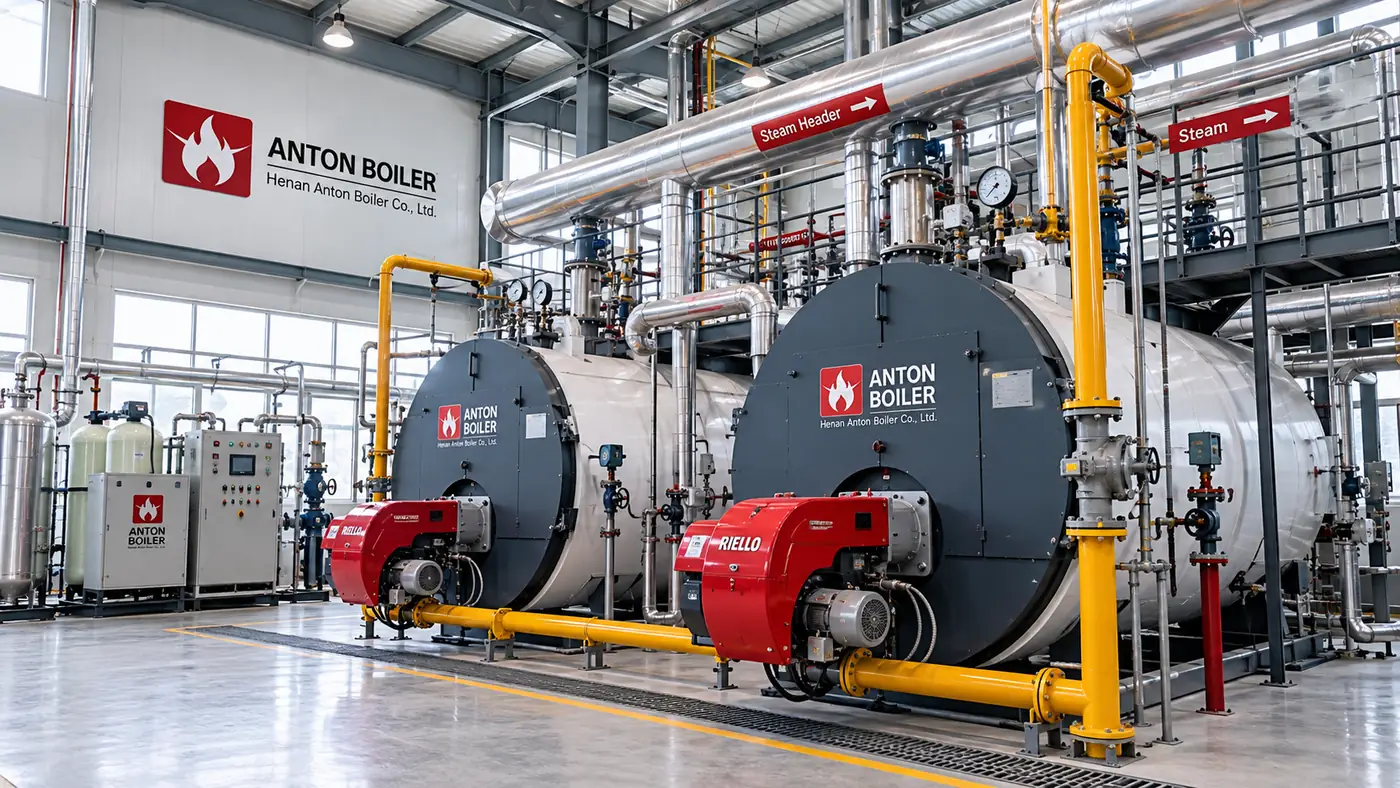
Multiple boilers must be connected and controlled correctly. Spirax Sarco’s guidance on steam headers and off-takes shows why header design and balanced pressure drop matter in parallel boiler systems.
The preferred arrangement depends on the actual profile, redundancy requirement, available space, fuel, local service capability and commercial evaluation.
12. Future Expansion and Design Allowances
Future capacity should be based on a defined project, not an undefined percentage added “just in case.”
Record future loads separately:
- Equipment name or production line
- Expected commissioning date
- Normal and peak demand
- Required pressure or temperature
- Expected simultaneous operation
Also separate:
- Process load
- Distribution loss
- Boiler-house consumption
- Confirmed future load
- Engineering allowance
This prevents the same uncertainty from being counted several times. A supplier can then show the base case and expansion case clearly.
13. Common Load-Profile Mistakes
Using Daily Fuel Consumption Alone
Daily fuel data can help estimate total energy use, but it may not show short demand peaks or minimum nighttime load.
Adding Every Nameplate
This can overstate demand when batch equipment does not operate simultaneously.
Using Only Production Average
Average output may miss startup, cleaning, sterilization and shift-change peaks.
Ignoring Low-Load Hours
Oversizing risk is often revealed by the minimum load, not the maximum load.
Mixing Different Pressure Levels
Steam users at different pressures should not be combined without considering pressure reduction, distribution and energy requirements.
Applying Repeated Safety Margins
Adding a margin to each equipment estimate and then adding another margin to the total can produce excessive capacity.
Treating Estimates as Measurements
Label every value as measured, calculated, manufacturer-provided or estimated.
14. Information to Send to a Boiler Supplier
Send the supplier a clear load-profile package containing:
- Industry and production process
- Required heat medium
- Minimum, normal and peak demand
- Startup and batch-cycle demand
- Peak duration and frequency
- Daily and weekly operating hours
- Simultaneous-load schedule
- Required pressure or supply/return temperature
- Fuel specification and supply conditions
- Feedwater analysis and condensate return
- Voltage and frequency
- Site altitude and climate
- Boiler-room dimensions and access
- Emission and inspection requirements
- Standby or redundancy requirement
- Confirmed future expansion
- Required scope of supply
Our industrial boiler quotation checklist explains the wider project information required before a technical and commercial proposal can be compared.
15. Frequently Asked Questions
What is a boiler load profile?
It is a time-based record or estimate of the steam flow or heat duty required by a facility. It shows how demand changes during startup, normal production, peaks, reduced shifts and standby periods.
Can I size a boiler from average steam consumption?
Not reliably. Average consumption should be checked against maximum sustained demand, short peaks, minimum load, pressure, operating schedule and future loads.
What is the difference between peak load and connected load?
Connected load is the sum of all installed users. Peak load is the highest realistic demand from the users that operate simultaneously.
How many days of data should an existing factory record?
Use enough data to capture normal production, startup, cleaning, different shifts and seasonal conditions. A single unusual day may not represent the facility. The appropriate period depends on process variability and data quality.
Does a short peak always require a larger boiler?
No. The supplier should review peak duration, frequency, allowable pressure variation, process scheduling, stored energy and the available boiler operating range. The solution is project-specific.
Is one large boiler better than two smaller boilers?
Not in every project. One boiler may be simpler and less expensive, while multiple boilers may match a wide load range and provide partial standby capacity. The decision should be based on the load profile, redundancy, space, controls and lifecycle cost.
What data must be confirmed before final model selection?
At minimum, confirm the load profile, pressure or temperature, fuel, water conditions, electrical supply, site conditions, codes, emissions and supply scope. Final model data must come from the supplier’s written technical proposal.
Conclusion
An industrial boiler load profile connects production reality with boiler capacity. It shows not only the highest demand but also the hours spent at normal and minimum load, the timing of startup and batch peaks, and the loads that operate together.
For an existing factory, use reliable meter trends and production records. For a new factory, build a time-based schedule from equipment data and batch cycles. Keep confirmed values separate from estimates, and avoid overlapping safety factors.
Once the load profile is complete, the supplier can evaluate capacity, operating range, sequencing, pressure stability, redundancy and auxiliary equipment on a clearer basis.
Request a Project-Specific Review
Anton Boiler supplies industrial steam boilers, hot-water boilers, thermal-oil heaters and electric boiler systems for international projects.
Send us your application, minimum/normal/peak demand, pressure or temperature, operating schedule, fuel, water information, installation country and required scope. Our team can review the project basis and prepare a technical proposal subject to final written confirmation.
Need a project-specific boiler load review?
Recommended Resources
- Industrial Boiler Sizing Guide
- Industrial Boiler Quotation Checklist
- Industrial Boiler Products
- Contact Anton Boiler
Pingback: Boiler Turndown Ratio for Industrial Load Matching
Pingback: Boiler Short Cycling: 7 Causes and Practical Fixes