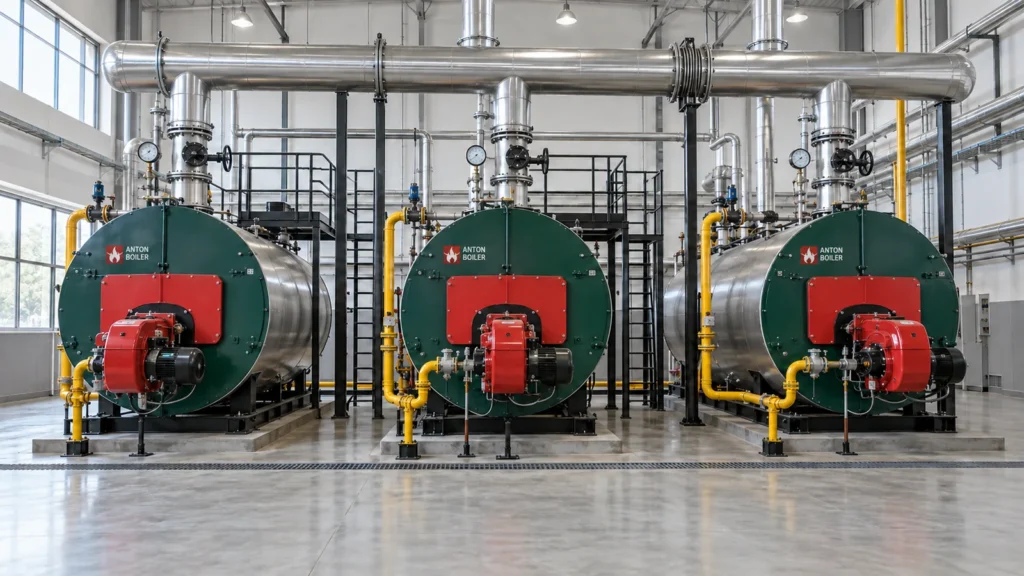
After calculating boiler capacity and preparing a realistic load profile, many factories face a second decision: should the required output come from one large boiler or from two or more smaller boilers operating together?
There is no universal answer. A single-boiler plant may be simpler, require fewer connections and have a lower initial equipment count. A multiple-boiler system may follow a wide load range more effectively, provide partial service during maintenance and allow capacity to be staged as demand changes. However, it also requires additional controls, valves, piping, auxiliaries, inspection points and maintenance planning.
The correct comparison starts with the factory’s minimum, normal and peak demand—not with the number of boilers. This guide explains how factory owners, engineers, procurement teams and EPC contractors can compare the two arrangements on a consistent technical and commercial basis.
This article follows our industrial boiler sizing guide and industrial boiler load profile guide. Complete those steps first if the project’s real demand has not yet been defined.
Quick Answer
A single boiler can be suitable when the load is relatively stable, planned shutdowns are acceptable, installation space is limited and the boiler can operate reliably across the required range. Multiple boilers deserve closer evaluation when demand varies widely, production must continue during maintenance, seasonal or batch loads change substantially, or future expansion will be introduced in stages. Compare both options using minimum, normal and peak load, usable boiler operating range, required standby capacity, sequencing controls, common-header design, auxiliary equipment, maintenance resources and total lifecycle cost. Final selection must use confirmed project data and manufacturer limits.
Key Takeaways
- Determine the factory load profile before deciding the number of boilers.
- One large boiler is not automatically less expensive once redundancy and low-load operation are considered.
- Multiple boilers are not automatically more efficient; poor sequencing can leave several units operating inefficiently at low fire.
- Define standby capacity explicitly instead of using the term “backup” without a required output.
- The usable turndown of the complete boiler-and-burner package must be confirmed in writing.
- Parallel steam boilers require properly designed headers, isolation, non-return protection, feedwater arrangements and controls.
- Auxiliary equipment must be checked for the maximum simultaneous operating case.
- Compare installed cost, operating cost, maintenance workload and downtime exposure—not boiler price alone.
- Illustrative examples in this article are not final Anton Boiler model selections.
Table of Contents
- Why this decision comes after boiler sizing
- What is a single-boiler system?
- What is a multiple-boiler system?
- Single boiler vs multiple boilers: comparison table
- Match the arrangement to the load profile
- Minimum load, turndown and short cycling
- Redundancy and production continuity
- Boiler sequencing and control strategy
- Steam headers and parallel connection
- Feedwater, blowdown and other auxiliaries
- Space, utilities and maintenance capability
- Compare lifecycle cost, not boiler price alone
- Illustrative selection scenarios
- A practical decision worksheet
- Common mistakes
- Information to send to the supplier
- Frequently asked questions
1. Why This Decision Comes After Boiler Sizing
The number of boilers cannot be selected responsibly until the required duty is understood.
A project should first identify:
- Minimum sustained load
- Normal operating range
- Maximum sustained load
- Short startup or batch peaks
- Peak duration and frequency
- Required steam pressure or hot-water temperatures
- Daily, weekly and seasonal operating schedule
- Loads that operate simultaneously
- Planned future production
- Required service during maintenance or equipment failure
A total demand of 6 t/h, for example, could represent very different factories. One may operate continuously between 5 and 6 t/h. Another may run at 1.5 t/h overnight, 3 to 4 t/h during normal production and 6 t/h only during short batch overlaps. The first plant and the second plant should not automatically receive the same boiler arrangement.
An industrial boiler load profile converts those operating conditions into a time-based demand picture. That profile becomes the basis for comparing one large boiler with several smaller units.
2. What Is a Single-Boiler System?
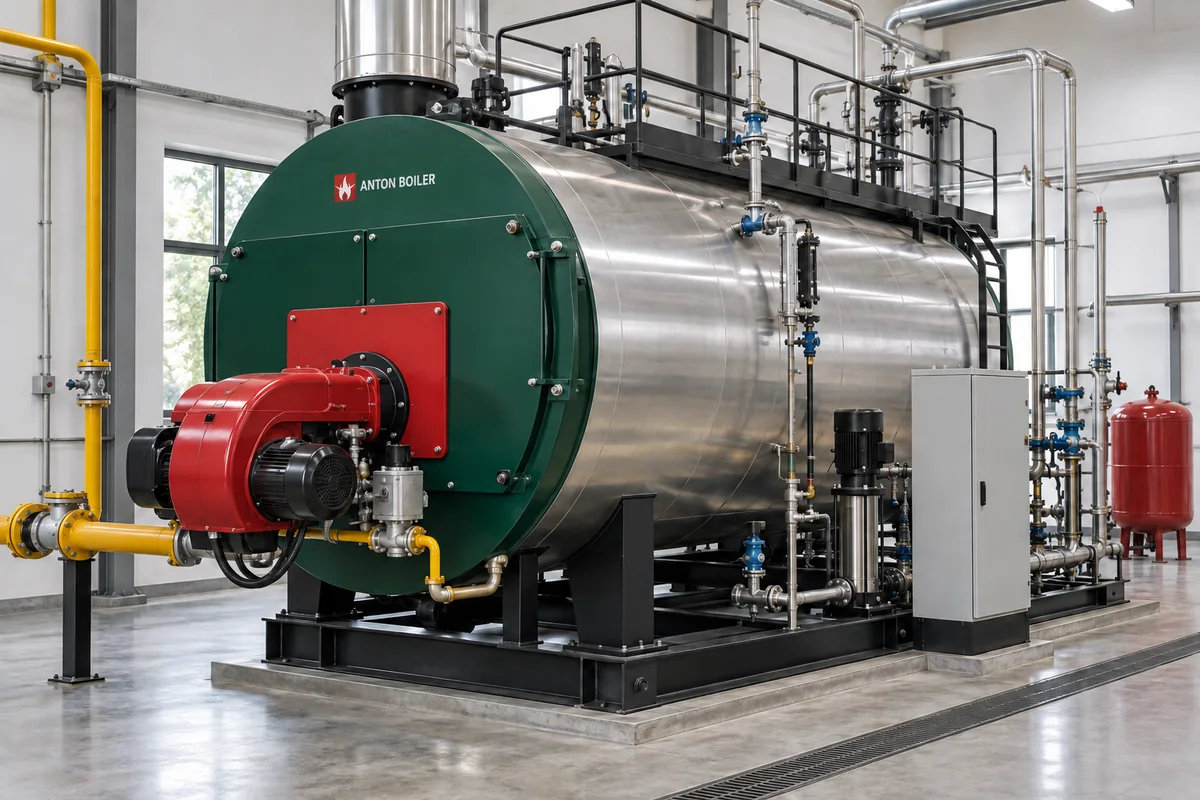
A single-boiler system uses one boiler to cover the required plant demand. Depending on the application, the installation may also include a burner or furnace, control cabinet, feedwater system, water treatment, blowdown equipment, fuel system, chimney, pumps and other auxiliaries.
Potential advantages include:
- Fewer major equipment items
- Simpler sequencing because only one boiler is fired
- Fewer boiler isolation and outlet connections
- Potentially lower initial equipment and installation complexity
- Less boiler-room floor area in some projects
- One maintenance program and one set of operating records
Potential limitations include:
- A planned shutdown may interrupt the full steam or heating supply
- An unexpected boiler outage may stop production unless another heat source is available
- A wide demand range may place the boiler at low load for long periods
- Future expansion may require a larger replacement or a later parallel addition
- The plant may depend heavily on one burner, one pressure vessel and one control system
These points are not guarantees. A single boiler with suitable modulation, good controls and a stable load can be an effective solution. The decision depends on the actual boiler package and operating conditions.
3. What Is a Multiple-Boiler System?
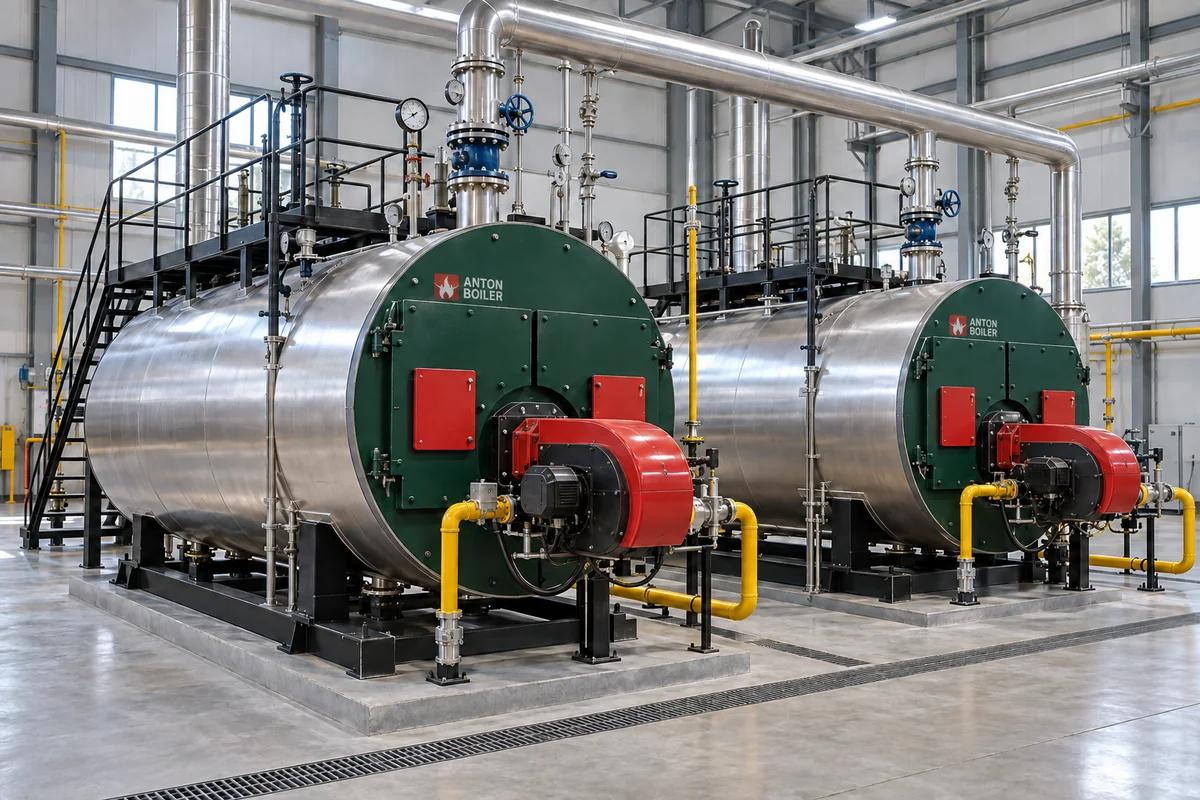
A multiple-boiler system uses two or more boilers connected to serve a common demand. The boilers may be identical or different in capacity, although mixed sizes require more careful control and maintenance planning.
The system may operate in stages. One boiler serves the lower load, another starts as demand rises, and additional units are brought online when required. A defined unit may also remain available as standby capacity.
Potential advantages include:
- Capacity can be staged as demand changes
- A smaller unit may cover nights, weekends or low-production periods
- Part of the system may remain available during planned maintenance
- Capacity can sometimes be expanded in defined phases
- Operators may rotate lead and lag units to balance running hours
Potential limitations include:
- More boilers, burners, controls, valves and inspection points
- More complex lead-lag or sequencing logic
- Greater piping and electrical scope
- Additional maintenance tasks and spare-parts planning
- Header and feedwater design become more important
- Poor control can cause simultaneous low-load operation or frequent starts
Multiple boilers should therefore be treated as one integrated boiler plant, not as several independent products placed in the same room.
4. Single Boiler vs Multiple Boilers: Comparison Table
| Decision Factor | One Large Boiler | Two or More Smaller Boilers |
|---|---|---|
| Stable base load | Often straightforward | May add unnecessary complexity unless standby is required |
| Wide load variation | Must confirm usable low-load operation | Staging may improve load matching |
| Planned maintenance | Full output may be unavailable | Partial output may remain available |
| Unexpected outage | Single point of production interruption | Remaining units may provide partial service |
| Controls | Generally simpler | Sequencing and communication are required |
| Steam header | One boiler connection | Parallel connection and load sharing require careful design |
| Auxiliary equipment | Usually fewer duplicated items | Shared and dedicated auxiliaries must be defined |
| Floor area | May be lower, depending on model and access | Often requires more boiler and service space |
| Installation scope | Fewer connections | More valves, cables, foundations and piping |
| Expansion | May require future replacement or parallel addition | Can sometimes be planned in modules |
| Maintenance workload | One major unit | More equipment, but maintenance can be staggered |
| Initial cost | May be lower in some projects | May be higher because of additional equipment and controls |
| Lifecycle risk | Concentrated in one unit | Distributed, but system complexity is higher |
This table is a screening tool, not a final design decision. The supplier should prepare both configurations against the same load, pressure, fuel, water, site and supply-scope assumptions.
5. Match the Arrangement to the Load Profile
The load profile should be divided into meaningful operating bands.
For example:
- Minimum sustained demand: 1.0 t/h
- Normal production demand: 3.0 to 4.0 t/h
- Maximum sustained demand: 5.0 t/h
- Short startup peak: 6.0 t/h for 30 minutes
This example does not prove that one 6 t/h boiler or two 3 t/h boilers is correct. The review must also consider:
- Whether the 6 t/h peak must be met entirely by boiler output
- Whether startup can be scheduled
- The confirmed minimum continuous output of each proposed boiler
- The burner modulation range
- Required pressure stability
- Steam storage within the boiler and system
- Future expansion
- Standby requirement
If the plant spends most hours near 4 to 5 t/h, one correctly selected boiler may operate consistently. If it spends many hours near 1 t/h and periodically rises to 5 t/h, staged boilers may provide better coverage. The conclusion must come from actual operating time at each load.
6. Minimum Load, Turndown and Short Cycling
Low-load operation is one of the main reasons to compare multiple boilers.
If a boiler cannot modulate down to the factory’s sustained minimum demand, it may repeatedly start and stop. Each burner cycle normally includes safe purge and ignition steps. Frequent cycling can increase heat losses, create pressure variation and add wear to burner and control components.
The U.S. Department of Energy’s Minimize Boiler Short Cycling Losses guidance notes that multiple small boilers can offer flexibility for following load swings and that a smaller boiler may be used when demand drops. The same guidance also emphasizes allocating load to the more efficient operating units.
Do not publish or assume one universal turndown ratio. Confirm the complete package:
- Boiler type and heat-transfer design
- Burner type
- Fuel
- Minimum firing rate
- Minimum continuous output
- Emission limits across the operating range
- Control method
- Start/stop limitations
For multiple boilers, calculate the combined operating range under the proposed sequence. A system with two boilers does not automatically achieve good turndown if both units are kept online at low fire.
7. Redundancy and Production Continuity
“We need a backup boiler” is not a complete design requirement.
Define what production must continue if one boiler is unavailable:
- 100% of peak demand
- 100% of normal demand
- One critical production line
- Building heating and frost protection only
- Safe shutdown capacity
- No standby capacity because planned outages are acceptable
This is often described using an N, N+1 or partial-redundancy concept, but the required output must be stated in actual units.
Consider a plant with a normal demand of 4 t/h and a peak of 6 t/h. Two 3 t/h boilers provide 6 t/h total, but the loss of one unit leaves only 3 t/h. That is not full 6 t/h redundancy. Whether it is acceptable depends on which processes can be reduced or stopped.
Redundancy also involves auxiliaries. Two boilers do not provide meaningful continuity if both depend on a single unprotected feedwater pump, electrical panel, fuel source or water-treatment train. Identify every common point whose failure could stop the complete plant.
8. Boiler Sequencing and Control Strategy
A multiple-boiler installation needs a defined operating sequence.
Typical control questions include:
- Which boiler starts first?
- At what header pressure or system demand does the next boiler start?
- When does a lag boiler stop?
- How are lead and lag duties rotated?
- How are different boiler sizes prioritized?
- How are minimum run time and restart delay handled?
- What happens after a sensor or communication failure?
- Can operators select manual and automatic modes safely?
The objective is not simply to make every boiler share the load equally. Depending on boiler and burner characteristics, it may be preferable to load one unit efficiently before starting another. Conversely, some hot-water systems and specific boiler technologies may use different parallel-control strategies. The control philosophy must be selected for the actual equipment.
The U.S. Department of Energy’s operations and maintenance guidance identifies boiler loading, sequencing, scheduling and control as important because changing loads can otherwise create inefficient low-load operation and short cycling.
Ask the supplier for a written sequence-of-operation document. It should describe normal start, load increase, load decrease, rotation, fault response and shutdown.
9. Steam Headers and Parallel Connection
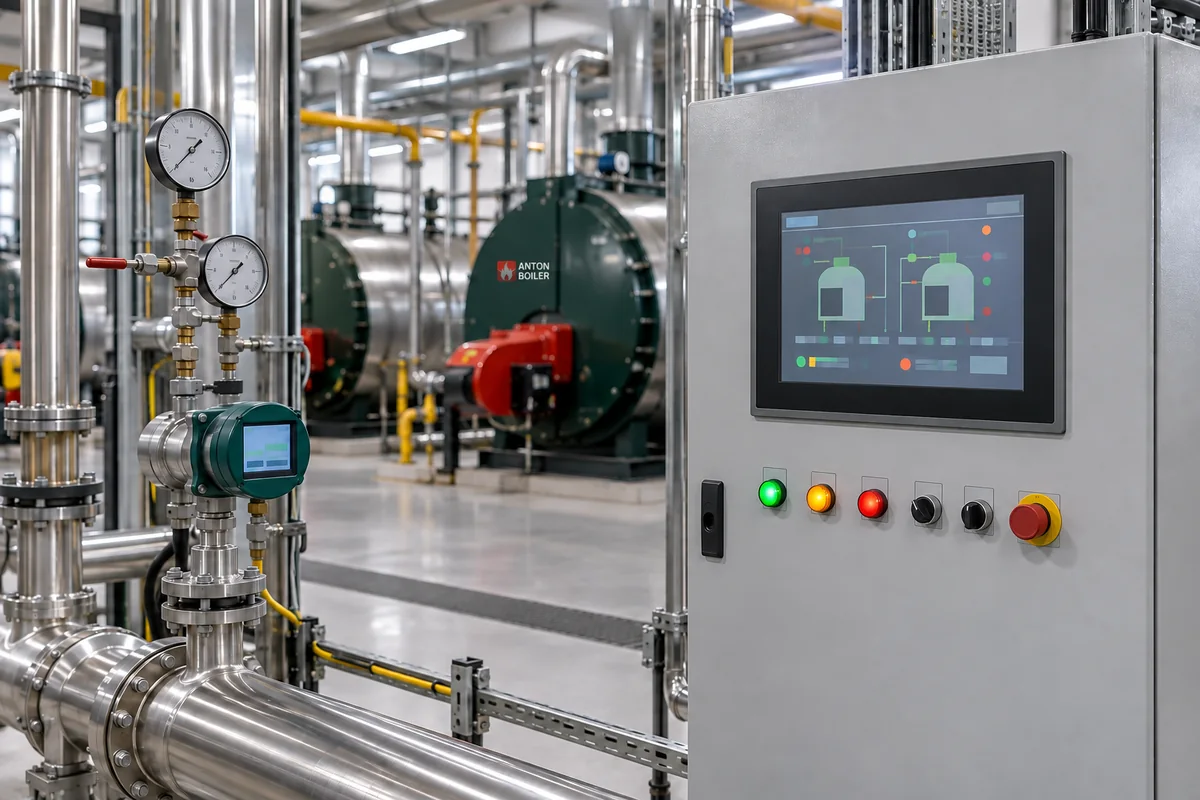
Parallel steam boilers discharge into a common header, but the connections must be arranged so that the boilers can share load without undesirable pressure-drop differences.
Spirax Sarco’s technical guidance on steam headers and off-takes explains that poorly arranged header connections can cause unequal loading between boilers. It also describes center off-takes or balanced arrangements for suitable multi-boiler systems.
The design should review:
- Boiler outlet pipe sizes
- Branch lengths and pressure drops
- Header diameter
- Location of the plant off-take
- Stop valves and non-return valves
- Warm-up and drainage
- Steam velocity and quality
- Expansion and supports
- Pressure controls and sensing locations
- Isolation for inspection and maintenance
Do not copy a generic header drawing without checking the current project capacity, pressure, boiler arrangement and local code requirements.
10. Feedwater, Blowdown and Other Auxiliaries
The boiler count affects the complete boiler-house scope.
Feedwater System
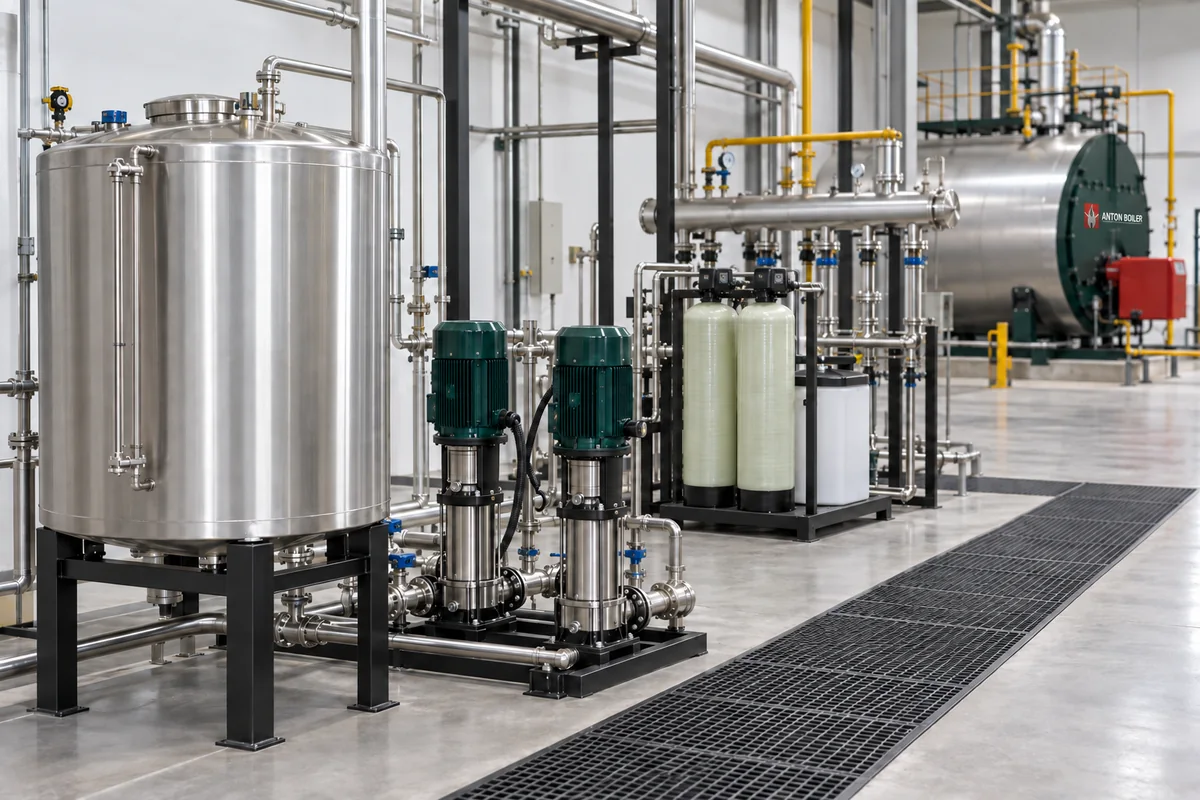
Confirm whether boilers use dedicated feed pumps, duty/standby pumps or a shared feedwater arrangement. The system must cover the maximum simultaneous evaporation rate, pressure and control method.
Water Treatment
Water-treatment capacity should reflect makeup-water demand, condensate return, operating schedule and required water quality—not simply the number of boilers.
Blowdown
Each boiler requires appropriate continuous and bottom blowdown arrangements. Multiple-boiler installations need safe isolation and a blowdown system sized and controlled for the permitted operating sequence.
Fuel Supply
The fuel train, pressure, pipe size, storage and pumping capacity must cover the maximum permitted simultaneous firing condition.
Electrical Supply
Add the electrical loads of burners, pumps, fans, controls and treatment equipment that may operate together. Confirm voltage, frequency, starting method and available site capacity.
Chimney and Flue Gas
Define whether each boiler has a dedicated stack or whether a common flue is proposed. This requires engineering review of draft, pressure, condensation, isolation, emissions and safe operation.
Emissions and Inspection
More boilers can mean more burners, stacks, monitoring points and inspection items. Confirm local authority requirements before finalizing the arrangement.
11. Space, Utilities and Maintenance Capability
Floor area alone is not enough. Review the complete maintenance envelope.
Check:
- Boiler transportation route
- Door and roof openings
- Tube-cleaning or access clearance
- Burner withdrawal space
- Valve and instrument access
- Pump and motor removal
- Chemical storage and water-treatment access
- Blowdown vessel location
- Chimney route
- Ventilation and combustion air
- Drainage
- Safe walkways and escape routes
Multiple boilers may require more installed space, but a very large single boiler may create transport, foundation or access problems. Site constraints should be shown on a dimensioned layout before the order is confirmed.
Maintenance capability also matters. Identical boiler packages can simplify spare-parts inventory and operator training. Mixed sizes may improve load matching but increase the number of burner, valve or control variants kept on site.
12. Compare Lifecycle Cost, Not Boiler Price Alone
A fair commercial comparison should use the same battery limits and operating assumptions.
Initial Installed Cost
Include:
- Boilers and burners
- Controls and sequencing panel
- Feedwater and water treatment
- Fuel system
- Piping, valves and header
- Electrical equipment and cabling
- Chimney or flue system
- Foundations and civil works
- Installation and commissioning
- Inspection and documentation
Operating Cost
Estimate fuel and electricity using the realistic load profile, not only the full-load rating. Consider standby losses, cycling, pump and fan operation, blowdown, water treatment and operator requirements.
Maintenance and Downtime
Compare planned service cost, inspection frequency, spare parts, cleaning time and the production consequence of an unavailable boiler.
Future Changes
If expansion is confirmed, price the base and future cases separately. A modular plan may reduce the initial installed capacity, but the future boiler space, header, utilities and controls should be reserved from the beginning.
The lowest boiler price is not necessarily the lowest project cost. The comparison should show the complete installed scope and the expected operating cases.
13. Illustrative Selection Scenarios
The following scenarios are examples only. They do not represent final Anton Boiler selections.
Scenario A: Stable Continuous Process
A factory operates around 80% to 95% of required capacity for most of the year. Planned annual shutdown is acceptable, and there is no requirement to maintain production during boiler maintenance.
One properly selected boiler may be a practical option, subject to confirmed operating range and site conditions.
Scenario B: Wide Day-and-Night Load Range
A factory has high daytime production but only tracing, cleaning or heating loads at night. Minimum demand is far below daytime demand.
Two or more boilers may deserve comparison so that a smaller unit can serve the low-load period. Final selection depends on verified minimum output, controls and operating hours.
Scenario C: Production Cannot Stop
A food, pharmaceutical or continuous-process plant requires partial steam supply during maintenance.
A multiple-boiler arrangement may reduce single-unit outage exposure. The factory must define which production loads remain essential and whether the remaining capacity is sufficient.
Scenario D: Seasonal Heating
A hot-water plant has a high winter design load but a much lower shoulder-season demand.
Multiple boilers or modular staging may improve seasonal coverage. Supply temperature reset, circulation flow and minimum boiler conditions must also be reviewed.
Scenario E: Planned Expansion
The initial project requires 3 t/h, and a confirmed second production phase will add another 2 t/h in eighteen months.
The first phase may reserve space, header capacity, electrical supply and controls for a second boiler. Alternatively, the full future demand may be installed initially if the current low-load operation remains acceptable. Both cases should be costed.
14. A Practical Decision Worksheet
Use this table before requesting a configuration proposal.
| Question | Project Answer | Confirmed By |
|---|---|---|
| Minimum sustained demand | ||
| Normal operating range | ||
| Maximum sustained demand | ||
| Short peak and duration | ||
| Required steam pressure or water temperatures | ||
| Hours per day and days per week | ||
| Seasonal variation | ||
| Required output with one boiler unavailable | ||
| Acceptable production reduction during maintenance | ||
| Future confirmed load and date | ||
| Fuel specification and supply pressure | ||
| Feedwater analysis and condensate return | ||
| Available boiler-room dimensions | ||
| Local emissions and inspection requirements | ||
| Operator and maintenance capability |
After this information is complete, ask the supplier to compare at least the technically credible options using the same assumptions.
15. Common Mistakes
Selecting the Number of Boilers Before Preparing the Load Profile
The plant may end up with unnecessary equipment or insufficient low-load coverage.
Calling Two Boilers “100% Backup” Without Calculating Remaining Capacity
The loss of one unit may leave only partial production capacity.
Comparing Boiler Prices With Different Supply Scopes
One quotation may include sequencing controls, pumps and header valves while another excludes them.
Assuming More Boilers Always Save Fuel
Several boilers running simultaneously at low fire can perform poorly. The actual sequence matters.
Ignoring Common-Mode Failures
A shared pump, power supply, fuel source or controller can stop every boiler.
Ignoring Header and Piping Balance
Parallel boilers require engineered connections; adding another boiler is not only an equipment purchase.
Using Catalogue Turndown Without Written Confirmation
Confirm the boiler, burner, fuel, emissions and control limits for the offered package.
Repeating Safety Margins
Do not add separate hidden margins to every process load, the total capacity and the standby case.
16. Information to Send to the Supplier
For a useful single-versus-multiple-boiler comparison, send:
- Industry and process application
- Steam, hot water or thermal oil requirement
- Minimum, normal, maximum and startup demand
- Peak duration and frequency
- Required pressure or supply/return temperatures
- Daily, weekly and seasonal schedule
- Loads that operate simultaneously
- Production requirement during maintenance
- Fuel type, specification and available pressure
- Feedwater analysis and condensate-return information
- Voltage and frequency
- Site altitude and climate
- Boiler-room dimensions, access and chimney constraints
- Emission limits and required inspection code
- Confirmed expansion plan
- Required supply scope and installation responsibility
Use our industrial boiler quotation checklist to prepare the wider project data before comparing proposals.
17. Frequently Asked Questions
Is one large boiler cheaper than two smaller boilers?
It may have fewer equipment items and connections, but the final installed cost depends on controls, redundancy, auxiliaries, piping, installation and downtime requirements. Compare equal supply scopes.
Are multiple boilers more efficient?
They can follow variable demand effectively when correctly sized and sequenced. They are not automatically more efficient. Poor staging can leave several boilers operating at inefficient low load.
What is boiler sequencing?
It is the control logic that starts, loads, unloads, rotates and stops boilers as plant demand changes. It should include normal operation and fault response.
What does N+1 mean for a boiler plant?
It generally means one additional unit beyond the number required for the defined duty. The project must still state the exact capacity required when one unit is unavailable.
Can two different-size boilers operate together?
They can in a properly engineered system, but the sequence, pressure controls, header design, feedwater arrangement and maintenance plan require careful review.
Does a second boiler eliminate all downtime risk?
No. Common fuel, water, power, pump, control or header failures can affect both boilers. The complete system must be reviewed for common points of failure.
How should multiple steam boilers connect to the header?
The branch and header arrangement should be engineered to control pressure drop, load sharing, drainage, isolation and steam quality. Do not use a generic layout without a project-specific calculation.
When is a single boiler usually worth considering?
When load is stable, the boiler can cover the operating range, planned shutdowns are acceptable, space or capital is constrained and no partial-service requirement exists.
What should Anton Boiler review before recommending the arrangement?
Send the load profile, pressure or temperature, schedule, standby requirement, fuel, water, utilities, site conditions, local compliance requirements, expansion plan and supply scope.
Conclusion: Choose the Boiler Plant, Not Just the Boiler
The decision between a single boiler and multiple boilers should be based on how the complete plant will operate.
One large boiler may offer a simpler installation for a stable load. Multiple smaller boilers may improve staging, maintenance flexibility and partial-service capability for variable or critical demand. Neither option is universally better.
Begin with verified minimum, normal and peak demand. Define the required output during maintenance. Confirm the usable operating range of each boiler, then compare controls, header design, auxiliaries, space, installed cost, operating cost and downtime exposure.
A clear project basis allows the supplier to explain why a proposed arrangement fits the factory rather than simply quoting a familiar boiler size.
Request a Project-Specific Boiler Configuration Review
Anton Boiler supplies industrial steam boilers, hot-water boilers, thermal-oil heaters, electric boilers and complete boiler-system solutions for international projects.
Send us your application, load profile, pressure or temperature, operating schedule, standby requirement, fuel, water information, installation country and required scope. Our team can compare technically credible single- and multiple-boiler arrangements, subject to final written confirmation of project data.
Need help comparing one boiler with a multiple-boiler arrangement?
Internal Links
- Industrial boiler sizing guide
- Industrial boiler load profile
- Industrial boiler quotation checklist
- Industrial boiler products
- Boiler project cases
- Contact Anton Boiler
External Technical Sources
- U.S. Department of Energy — Minimize Boiler Short Cycling Losses
- U.S. Department of Energy — Purchasing Energy-Efficient Boilers
- U.S. Department of Energy — Operations & Maintenance Best Practices Guide
- Spirax Sarco — Steam Headers and Off-takes
- Spirax Sarco — Introduction to the Boiler House
Technical and Compliance Note
This article provides general industrial boiler selection guidance. Example loads and configurations are illustrative and are not final engineering calculations, model recommendations or guarantees of savings. Final boiler quantity, capacity, pressure, controls, piping, safety devices, emissions, inspection and installation must be confirmed against project data, the offered manufacturer’s documentation and applicable local requirements.