A boiler can have enough capacity for a factory’s peak demand and still be a poor match for its normal operation. The reason is simple: industrial demand rarely stays at one value. Production may rise during startup, settle into a normal band, fall between batches and drop sharply at night or on weekends.
Boiler turndown ratio helps describe how far a burner or boiler package can reduce its firing rate while maintaining controlled combustion. It therefore connects the nameplate maximum to the lowest load the equipment can serve without shutting the burner off. A higher stated ratio may widen the operating range, but it is not a complete efficiency guarantee and must not be separated from the fuel, burner, boiler, controls, emissions requirements and real factory load profile.
This guide is for factory owners, plant engineers, procurement teams and EPC contractors comparing industrial steam, hot-water or thermal-oil systems. It explains the calculation, the practical limits, the relationship with short cycling and the information that should be confirmed before a boiler is selected.
If the project’s demand has not yet been defined, first read our industrial boiler sizing guide and industrial boiler load profile guide. If the demand range is already known, use this article together with our guide to one large boiler versus multiple smaller boilers.
Quick Answer
Boiler turndown ratio is the ratio of the maximum controllable firing rate to the minimum controllable firing rate. A burner rated at 10:1 turndown can theoretically reduce to 10% of its maximum firing rate; a 5:1 ratio corresponds to 20%. The usable plant turndown may be narrower because of burner stability, fuel properties, boiler heat-transfer limits, emissions, pressure or temperature control, and manufacturer settings. Compare the confirmed minimum continuous output with the factory’s minimum sustained load. If demand repeatedly falls below that limit, the burner may cycle, and the project may need different controls, a smaller unit, multiple-boiler staging or process-load scheduling.
Key Takeaways
- Turndown ratio describes an operating range; it does not describe total boiler capacity by itself.
- The basic calculation is maximum controllable firing rate divided by minimum controllable firing rate.
- Minimum firing percentage is approximately 100 divided by the turndown ratio.
- Burner turndown and usable boiler-package turndown are not always the same.
- A high headline ratio does not automatically prove better seasonal efficiency, lower emissions or stable steam pressure.
- Minimum sustained factory demand should be compared with the confirmed minimum continuous output of the offered package.
- Frequent on-off cycling introduces purge periods and should be evaluated rather than accepted as normal low-load operation.
- Fuel type, burner design, controls, furnace conditions and emissions limits can change the usable range.
- Multiple boilers can extend plant-level load coverage only when sequencing is designed correctly.
- Every ratio used for procurement should be confirmed in the supplier’s technical offer for the actual fuel and operating conditions.
- All calculations below are illustrative and are not Anton Boiler model guarantees.
Table of Contents
- What is boiler turndown ratio?
- Boiler turndown ratio formula
- Burner turndown versus boiler-package turndown
- Why minimum load matters
- Turndown ratio and boiler short cycling
- What determines the usable turndown range?
- Fuel type and burner technology
- Steam, hot-water and thermal-oil applications
- One boiler versus multiple boilers
- Illustrative load-matching examples
- What a higher turndown ratio does not guarantee
- Questions to ask a boiler supplier
- A practical turndown review worksheet
- Common selection mistakes
- Frequently asked questions
1. What Is Boiler Turndown Ratio?
Boiler turndown ratio is commonly used to describe the relationship between the maximum and minimum controllable firing rates of a burner or boiler package.
The U.S. Department of Energy’s Upgrade Boilers with Energy-Efficient Burners tip sheet defines turndown as the maximum inlet fuel or firing rate divided by the minimum firing rate. Spirax Sarco similarly describes burner turndown as the ratio between maximum firing rate and minimum controllable firing rate.
The word controllable is important. A burner must do more than continue producing a flame. Across the stated range, it must maintain safe ignition, flame stability, suitable fuel-air control and the performance conditions required by the equipment design and local rules.
The ratio is normally written in forms such as:
- 3:1
- 4:1
- 5:1
- 10:1
A 5:1 ratio does not mean the boiler produces five times its rated capacity. It means the maximum controlled firing rate is five times the minimum controlled firing rate.
2. Boiler Turndown Ratio Formula
The basic formula is:
Turndown ratio = Maximum controllable firing rate ÷ Minimum controllable firing rate
The corresponding minimum firing percentage is:
Minimum firing percentage = 100 ÷ Turndown ratio
Simple Conversion Table
| Stated Turndown Ratio | Theoretical Minimum Firing Percentage |
|---|---|
| 2:1 | 50% |
| 3:1 | 33.3% |
| 4:1 | 25% |
| 5:1 | 20% |
| 6:1 | 16.7% |
| 8:1 | 12.5% |
| 10:1 | 10% |
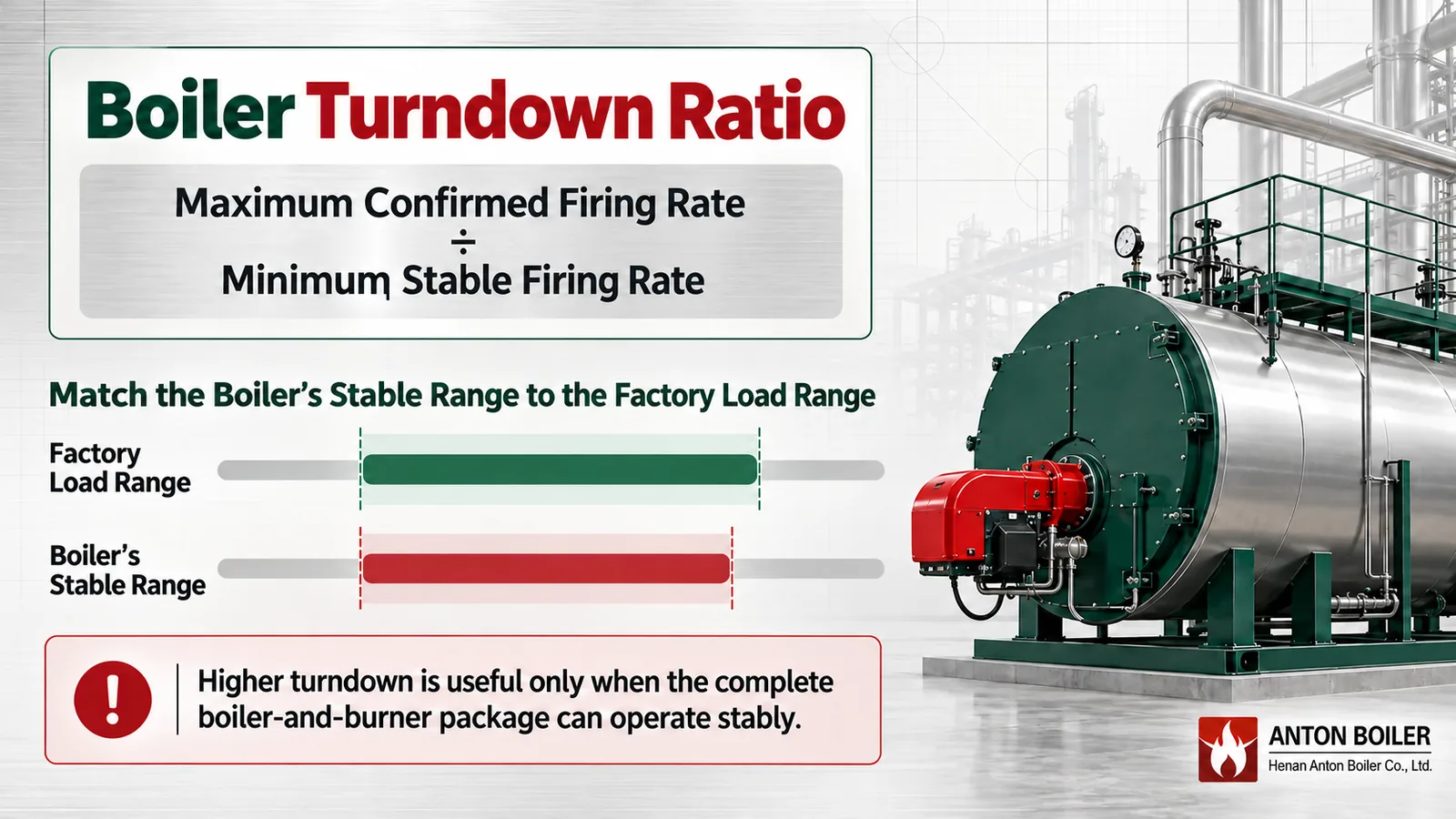
These percentages are mathematical conversions, not proof that a boiler will deliver the same percentage of rated steam or heat output under every site condition.
Illustrative Firing-Rate Example
Assume a burner has:
- Maximum controlled fuel input: 8 MW
- Minimum controlled fuel input: 1.6 MW
Then:
8 MW ÷ 1.6 MW = 5:1
The theoretical minimum firing percentage is:
100 ÷ 5 = 20%
This example explains the calculation only. The final relationship between fuel input and useful output depends on the boiler, fuel, combustion conditions, heat losses and control settings.
3. Burner Turndown Versus Boiler-Package Turndown
Procurement documents sometimes use “burner turndown” and “boiler turndown” as if they are identical. They should be separated and confirmed.
Burner Turndown
Burner turndown describes the firing range over which the burner can control fuel and combustion air while maintaining safe and stable operation.
Boiler-Package Turndown
The usable boiler-package range may also depend on:
- Furnace dimensions and heat-release limits
- Required steam pressure or fluid temperature
- Flame geometry and impingement risk
- Boiler circulation and heat-transfer conditions
- Minimum stack-temperature or condensation constraints
- Fuel-gas pressure and quality
- Oil viscosity, heating and atomization conditions
- Combustion-air fan and damper control
- Oxygen-trim and parallel-positioning capability
- Emissions limits at low and high fire
- Control-sensor range and response
- Manufacturer commissioning settings
A burner brochure may state a wide ratio, but that number should not automatically be transferred to the complete boiler quotation. The supplier should confirm the guaranteed or allowable range for the actual boiler, burner, fuel and project conditions.
4. Why Minimum Load Matters
Factories often focus on peak demand because insufficient capacity can stop production. Minimum demand receives less attention, even though it may dominate nights, weekends, seasonal operation or time between batches.
Compare these two projects:
Factory A: Narrow Load Range
- Minimum sustained demand: 4.2 t/h
- Normal demand: 4.8 to 5.5 t/h
- Maximum sustained demand: 6.0 t/h
Factory B: Wide Load Range
- Minimum sustained demand: 0.8 t/h
- Normal demand: 2.5 to 4.0 t/h
- Maximum sustained demand: 6.0 t/h
Both factories have the same 6.0 t/h maximum. They do not have the same operating requirement. Factory B needs a much wider usable range or a different system arrangement to cover long low-load periods.
The correct review therefore asks:
- What is the minimum sustained load?
- How long does it last?
- How often does it occur?
- Is the load measured, calculated or estimated?
- What pressure or temperature must be maintained during that period?
- Can production loads be scheduled differently?
- Must one boiler cover the full range, or can several units be staged?
5. Turndown Ratio and Boiler Short Cycling
When heat demand falls below the minimum stable output, the control system may stop the burner. The burner later restarts when pressure or temperature falls. Repeated short firing periods followed by stops are commonly described as short cycling.
The U.S. Department of Energy’s Minimize Boiler Short Cycling Losses explains that a boiler cycle includes a firing interval, post-purge, idle period, pre-purge and return to firing. During purge periods, air passes through the boiler and can remove heat. The same DOE guidance recommends considering a higher-turndown burner or a smaller boiler when a boiler is oversized relative to the load.
Short cycling should not be diagnosed from a single observation. A technical review should record:
- Starts per hour or per shift
- Average firing duration
- Pre-purge and post-purge time
- Pressure or temperature control band
- Minimum and maximum firing command
- Actual steam flow or heat duty
- Fuel use during representative production periods
- Burner alarms and failed starts
- Process events that create the cycle
- Whether several boilers are online simultaneously
Potential consequences can include:
- Additional purge-related heat loss
- More frequent ignition sequences
- Pressure or temperature variation
- Increased wear on ignition and switching components
- Operator intervention
- Difficulty maintaining efficient fuel-air control at low load
These effects depend on the equipment and operating pattern. A supplier should not promise a fixed percentage saving from a higher turndown ratio without measured baseline data and a defined comparison.
6. What Determines the Usable Turndown Range?
Burner and Flame Stability
The burner must maintain a stable flame across the firing range. Ignition, flame detection and low-fire stability are safety-critical functions and must follow the burner manufacturer’s instructions.
Fuel-Air Control
Fuel and combustion air must remain coordinated as the firing rate changes. Mechanical linkage, electronic ratio control, parallel positioning and oxygen trim offer different levels of control and commissioning complexity.
Furnace and Boiler Design
The firing system must suit the furnace geometry and heat-release limits. A burner capable of a broad laboratory range may have a narrower approved range when applied to a particular boiler.
Fuel Conditions
Gas pressure, calorific value, oil viscosity, atomizing medium and fuel cleanliness can affect burner performance. The ratio must be confirmed for the actual fuel specification rather than copied from an unrelated project.
Emissions and Local Requirements
A burner may remain lit at low fire but fail to satisfy the required emissions or combustion-performance conditions. The usable range must consider the applicable local limits and test basis.
Boiler Controls
Pressure, temperature, oxygen and flow sensors need suitable ranges and response. Poorly tuned controls can create hunting, overshoot or unnecessary cycling even when the hardware is capable of wider modulation.
System Demand and Stored Energy
Steam volume, water content, headers, process vessels and distribution pipework can affect how quickly the system responds. Turndown is one part of the dynamic system, not a substitute for a load profile.
7. Fuel Type and Burner Technology
Turndown capability can differ by fuel and combustion technology. A gas burner, pressure-jet oil burner, rotary-cup burner, biomass grate or coal-fired furnace should not be assigned the same generic ratio.
Gas-Fired Systems
Gas systems may support modulating control over a useful range when fuel pressure, valves, air control and burner design are suitable. The actual ratio must be confirmed for the selected burner and local gas conditions.
Oil-Fired Systems
Oil viscosity, preheating, atomization and burner type affect low-fire performance. A ratio stated for natural gas should not be assumed for diesel, heavy fuel oil or a dual-fuel configuration.
Dual-Fuel Systems
The turndown ratio may be different on each fuel. The quotation should state the range separately for gas and oil, together with any changeover limitations.
Biomass and Coal-Fired Systems
Solid-fuel systems have different fuel-feeding, bed, grate, furnace and response characteristics. Fuel moisture, particle size, ash and feeding consistency can influence controllability. Do not apply a gas-burner ratio to a coal or biomass boiler.
Electric Boilers
Electric boilers are controlled differently, often by staging heating elements or electronic power control. The relevant minimum step and control range should be confirmed from the offered electrical design rather than expressed automatically as burner turndown.
8. Steam, Hot-Water and Thermal-Oil Applications
Steam Boilers
Steam demand is commonly expressed in kg/h, t/h or lb/h at a defined pressure. Review minimum stable demand, pressure control, steam quality, feedwater temperature and batch peaks. The stated firing ratio does not by itself guarantee the same steam-output ratio.
Hot-Water Boilers
Hot-water demand depends on thermal duty, flow rate and supply-and-return temperatures. For building heating, outdoor temperature and seasonal demand can produce long low-load periods. Process hot-water systems may instead have sharp batch changes.
Thermal-Oil Heaters
Thermal-oil systems require review of process duty, supply and return temperatures, circulation flow and minimum-flow protection. Burner modulation must work together with fluid circulation and process controls.
For all three, the project should define the load in engineering units and identify the duration of each operating condition.
9. One Boiler Versus Multiple Boilers
A high turndown ratio can widen the range of one boiler, but it does not automatically replace the need to compare multiple units.
One Boiler May Be Suitable When
- The load is relatively stable.
- The minimum load is within the confirmed continuous operating range.
- Planned shutdowns are acceptable.
- Space and installation simplicity are important.
- The plant does not require partial output during maintenance.
Multiple Boilers May Be Worth Comparing When
- Demand changes widely between shifts or seasons.
- The minimum demand is far below the peak.
- Production must continue during maintenance.
- Different process lines operate on different schedules.
- Expansion will be introduced in defined phases.
- A smaller lead boiler can cover long low-load periods.
The plant-level range depends on the number and size of boilers, each unit’s minimum output and the sequencing logic. Poor sequencing can keep several boilers at low fire instead of allowing one unit to operate in a better range.
Read the complete comparison in Single Boiler vs Multiple Boilers: Which Is Better for Your Factory?.
10. Illustrative Load-Matching Examples
The following examples explain the method. They are not equipment selections or guaranteed Anton Boiler performance.
Example A: One Boiler with a Confirmed 5:1 Range
Assume a proposed boiler package has:
- Rated useful output: 5,000 kW
- Confirmed usable output range for the stated project conditions: 20% to 100%
- Minimum continuous useful output: 1,000 kW
Factory demand is:
- Minimum sustained load: 1,400 kW
- Normal load: 2,800 to 4,000 kW
- Peak load: 4,800 kW
In this simplified example, the minimum sustained demand remains above the stated minimum continuous output. One boiler may therefore be screened for further technical review. The supplier must still confirm control performance, fuel, temperatures, emissions, auxiliaries and required standby capacity.
Example B: Minimum Load Below the Confirmed Range
Assume the same 5,000 kW boiler, but factory demand falls to 450 kW for six hours every night.
The 450 kW load is below the example 1,000 kW minimum continuous output. The review should not ignore this gap. Possible paths include:
- Investigate whether the night load can be scheduled differently.
- Compare a boiler with a wider confirmed operating range.
- Compare two differently sized or equal-sized boilers with proper sequencing.
- Consider a dedicated smaller unit for the low-load service.
- Review whether thermal storage is technically and commercially suitable.
The correct option depends on the process and complete system cost.
Example C: Burner Ratio Versus Steam Output
A supplier states a 10:1 burner turndown ratio for a gas burner. The buyer assumes a 10 t/h steam boiler can therefore operate continuously at 1 t/h.
That conclusion is not yet proven. The buyer should request confirmation of:
- Whether 10:1 applies to the selected burner model and fuel
- Whether it applies when installed on the proposed boiler
- The guaranteed or allowable minimum continuous steam output
- Pressure stability and steam-quality conditions at low load
- Emissions and oxygen limits across the range
- Commissioning and test conditions
11. What a Higher Turndown Ratio Does Not Guarantee
A higher number may be useful, but it does not independently guarantee:
- Higher boiler efficiency at every load
- Lower fuel consumption under every operating schedule
- Lower NOx or carbon monoxide across the full range
- Better steam quality
- Stable pressure with poorly tuned controls
- Suitability for a different fuel
- Elimination of all burner cycling
- Adequate standby capacity
- Lower lifecycle cost
- Compatibility with the factory’s process dynamics
Turndown should therefore be evaluated together with the efficiency test basis, excess oxygen, emissions, minimum output, control philosophy and load-duration profile.
12. Questions to Ask a Boiler Supplier
Ask the supplier to answer these questions in the technical offer:
- Is the stated ratio a burner value or a complete boiler-package value?
- What maximum and minimum firing rates define the ratio?
- What is the minimum continuous useful output in kg/h, t/h, kW or MW?
- Which fuel specification is used for the stated range?
- Is the ratio different for gas, diesel or other backup fuel?
- What pressure or temperature conditions apply?
- What combustion-control method is included?
- Are oxygen trim and variable-speed drives included or optional?
- What emissions limits apply across the operating range?
- Which factory and site tests can verify the performance?
- What commissioning settings and operator training are required?
- When does the burner transition to on-off cycling?
- How does the proposed range compare with the factory load-duration profile?
- Would one boiler or multiple boilers provide a better verified match?
13. Practical Turndown Review Worksheet
Complete this table before accepting a ratio in a quotation.
| Review Item | Project Requirement | Supplier Confirmation | Status |
|---|---|---|---|
| Heat medium | Confirmed / Pending | ||
| Maximum sustained load | Confirmed / Pending | ||
| Minimum sustained load | Confirmed / Pending | ||
| Low-load duration | Confirmed / Pending | ||
| Startup or batch peak | Confirmed / Pending | ||
| Required pressure or temperatures | Confirmed / Pending | ||
| Fuel type and specification | Confirmed / Pending | ||
| Maximum firing rate | Confirmed / Pending | ||
| Minimum firing rate | Confirmed / Pending | ||
| Stated burner turndown ratio | Confirmed / Pending | ||
| Usable boiler-package range | Confirmed / Pending | ||
| Minimum continuous useful output | Confirmed / Pending | ||
| Low-load emissions basis | Confirmed / Pending | ||
| Control method | Confirmed / Pending | ||
| One or multiple boilers | Confirmed / Pending | ||
| Test and commissioning method | Confirmed / Pending |
Use the worksheet together with the industrial boiler quotation information checklist.
14. Common Selection Mistakes
Mistake 1: Selecting Only by Peak Capacity
Peak capacity matters, but the minimum and normal operating bands determine how the boiler will behave for much of the year.
Mistake 2: Treating Burner Turndown as Guaranteed Steam Output
Request the minimum continuous useful output of the complete package under the specified operating conditions.
Mistake 3: Comparing Ratios Based on Different Fuels
A ratio stated for natural gas may not apply to diesel, heavy oil, biomass or coal.
Mistake 4: Ignoring Duration
A ten-minute low-load interval is different from six hours of night operation. Record both demand and duration.
Mistake 5: Assuming the Highest Ratio Is Automatically Best
Control quality, combustion performance, emissions, maintenance and total system cost must also be compared.
Mistake 6: Applying One Generic Ratio to Every Anton Boiler Model
Anton Boiler should confirm the offered model, burner and fuel combination. Do not reuse a ratio from another quotation or project without verification.
Mistake 7: Ignoring Multiple-Boiler Sequencing
Two boilers do not create useful plant turndown unless lead-lag staging, rotation and fault response are designed correctly.
15. Frequently Asked Questions
What is a good boiler turndown ratio?
There is no universal “good” ratio. The useful value is one that lets the confirmed boiler-and-burner package follow the project’s minimum-to-maximum load range while maintaining safe combustion, required pressure or temperature, emissions compliance and acceptable efficiency. Compare the ratio with the load-duration profile, not with another headline number alone.
How do I calculate minimum firing rate from turndown ratio?
Divide 100 by the turndown ratio. A 5:1 ratio corresponds mathematically to 20% minimum firing; 10:1 corresponds to 10%. This conversion applies to the stated firing basis. Ask the supplier to confirm the complete package’s minimum continuous useful output separately.
Is boiler turndown the same as burner turndown?
Not always. Burner turndown describes the burner’s controllable firing range. The usable boiler-package range may be narrower because of furnace conditions, fuel, emissions, boiler circulation, control settings and required output quality. Procurement documents should state clearly which ratio is being quoted.
Does a higher turndown ratio prevent short cycling?
A wider confirmed range can reduce cycling when demand remains within that range, but it cannot guarantee that cycling will disappear. Demand may still fall below minimum output, controls may be poorly tuned, or several boilers may be sequenced incorrectly. Review the actual starts, load profile and controls.
Can multiple boilers improve plant turndown?
They can widen plant-level load coverage when smaller units are staged correctly. The minimum plant output is influenced by the smallest operating unit and its minimum stable output. Sequencing should shut unnecessary units down rather than leave several boilers operating inefficiently at low fire.
Does turndown ratio apply to coal or biomass boilers?
Solid-fuel systems have different fuel-feeding, grate, furnace and response characteristics. Do not apply a gas-burner ratio to coal or biomass equipment. Ask for the allowable load range and minimum stable output for the specific fuel and combustion system.
What information should I send Anton Boiler?
Send the heat medium, minimum, normal and peak demand, load duration, pressure or temperatures, operating schedule, fuel specification, feedwater or circulating-fluid data, site conditions, emissions limits, voltage, redundancy requirement and required supply scope. Mark every value as measured, calculated or estimated.
Conclusion: Match the Confirmed Range to the Real Load
Boiler turndown ratio is valuable because it connects maximum firing with minimum controllable firing. It helps engineers judge whether one boiler can follow the factory’s demand range or whether a smaller lead unit, multiple-boiler staging or another operating strategy deserves comparison.
Do not select a boiler from the ratio alone. Build a time-based load profile, verify the minimum sustained demand and request the usable range of the complete boiler-and-burner package for the actual fuel, pressure or temperature, emissions requirements and controls.
For a project-specific review, send Anton Boiler your operating data through the contact page. We can use the same confirmed project conditions to compare capacity, operating range, one-versus-multiple-boiler arrangements and auxiliary scope.
Technical and Evidence Note
- All numerical project examples in this article are illustrative and are not Anton Boiler product guarantees.
- Final turndown, minimum output, emissions, efficiency and control performance must be confirmed for the selected boiler, burner, fuel and site conditions.
- The U.S. Department of Energy tip sheets cited below were published in 2012. They remain useful engineering references for burner turndown and short-cycling concepts but must not replace current manufacturer data, local regulations or project-specific testing.
- No real customer operating data is disclosed in this article.
Sources
- U.S. Department of Energy, Minimize Boiler Short Cycling Losses, Steam Tip Sheet #16, January 2012: https://www.energy.gov/sites/default/files/2014/05/f16/steam16_cycling_losses.pdf
- U.S. Department of Energy, Upgrade Boilers with Energy-Efficient Burners, Steam Tip Sheet #24, January 2012: https://www.energy.gov/sites/default/files/2014/05/f16/steam24_burners.pdf
- U.S. Department of Energy, Purchasing Energy-Efficient Boilers: https://www.energy.gov/cmei/femp/purchasing-energy-efficient-boilers
- Spirax Sarco, Boiler Efficiency and Combustion: https://www.spiraxsarco.com/learn-about-steam/the-boiler-house/boiler-efficiency-and-combustion
Request a Boiler Load-Matching Review
Send Anton Boiler your minimum, normal and peak demand, operating schedule, pressure or temperatures, fuel specification, site conditions and required standby capacity. We will review the project data before recommending a boiler configuration.