Choosing between a fire-tube boiler and a water-tube boiler is not simply a matter of selecting the design with the larger capacity or higher stated pressure.
The correct decision depends on the factory’s steam demand, working pressure, load profile, available fuel, feedwater quality, installation space, maintenance resources, local regulations and total supply scope.
Both designs can provide reliable industrial steam when properly selected, manufactured, installed and operated. However, they differ in construction, operating characteristics and project suitability.
This guide explains the main differences between fire-tube and water-tube boilers and provides a practical selection process for factory owners, engineers, procurement teams and EPC contractors.
Quick Answer
A fire-tube boiler is commonly considered for industrial projects requiring a relatively straightforward steam system, stable operation and accessible routine maintenance.
A water-tube boiler is generally considered when a project involves more demanding steam conditions, larger or rapidly changing loads, higher operating requirements or a more engineered boiler system.
The final choice must be reviewed using the actual steam demand, working pressure, load profile, fuel, water quality, site conditions, applicable codes and required supply scope.
Key Takeaways
- Fire-tube boilers pass hot combustion gases through tubes surrounded by water.
- Water-tube boilers circulate water or a steam-water mixture inside tubes heated externally.
- Neither design is automatically better for every industrial project.
- Capacity and pressure should not be considered in isolation.
- Load variation, water quality and local maintenance capability matter.
- Fuel and emission requirements affect the burner and auxiliary system.
- Buyers should compare complete supply boundaries, not boiler-body prices alone.
- Final technical parameters must be confirmed for the actual project.
Fire Tube vs Water Tube Boiler Comparison
| Comparison Point | Fire-Tube Boiler | Water-Tube Boiler |
|---|---|---|
| Basic construction | Hot gases flow inside tubes surrounded by water | Water or steam-water mixture flows inside tubes |
| Typical project approach | Often considered for relatively straightforward industrial steam duties | Often considered for more demanding or highly engineered duties |
| Water content | Generally higher | Generally lower relative to output |
| Load response | Usually more gradual | Can suit rapid load changes when properly designed |
| Maintenance | Tube access may be comparatively straightforward, depending on design | Requires disciplined inspection and specialist maintenance |
| Water treatment | Proper treatment is required | Water-chemistry control is especially important |
| Installation | Can be supplied as a compact packaged system in suitable applications | May require a more project-specific arrangement |
| Selection basis | Application, pressure, capacity, fuel and site conditions | Application, pressure, capacity, load profile, water quality and system design |
This is a general comparison. It does not establish universal pressure or capacity limits.
1. How Does a Fire-Tube Boiler Work?
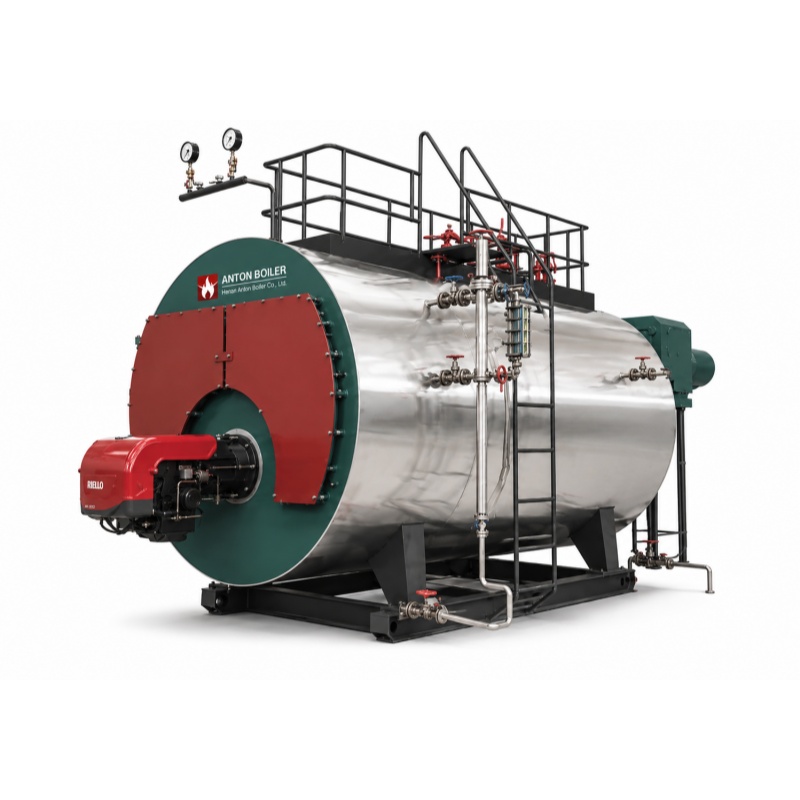
In a fire-tube boiler, combustion gases pass through tubes surrounded by water inside the boiler shell.
Heat transfers from the gases through the tube walls into the water. As the water absorbs heat, steam is produced and collected in the steam space.
Many packaged industrial steam boilers use fire-tube construction because the boiler body, burner, controls and selected auxiliary equipment can be integrated into a factory-assembled system.
Relevant Anton Boiler product information:
Explore the WNS oil and gas steam boiler
2. How Does a Water-Tube Boiler Work?
In a water-tube boiler, water or a steam-water mixture flows inside tubes while hot combustion gases pass around their external surfaces.
The configuration can support engineered circulation, heat-transfer and steam-separation arrangements for demanding operating conditions.
Water-tube systems may include drums, headers, circulation components, pressure parts, controls and extensive water-treatment requirements. The complete system must therefore be evaluated rather than the boiler body alone.
3. When Is a Fire-Tube Boiler a Practical Choice?
A fire-tube boiler may be considered when the project has:
- A relatively stable steam demand
- Clearly defined working pressure
- A preference for packaged equipment
- Limited onsite assembly resources
- Routine industrial process-steam requirements
- A need for accessible inspection and cleaning
- Suitable gas, oil or dual-fuel conditions
- Adequate boiler-room access
Potential applications include food processing, textiles, packaging, laundry, hotel services, hospitals and other industrial facilities.
Application alone does not determine the boiler type. The actual capacity, pressure, load profile, steam quality and local regulations must still be reviewed.
4. When Is a Water-Tube Boiler a Practical Choice?
A water-tube boiler may be considered when the project involves:
- Demanding operating pressure
- Large or highly variable steam loads
- Rapid response requirements
- Complex process-steam conditions
- Continuous industrial operation
- Project-specific engineering or code requirements
- Integration with a larger energy system
- A capable water-treatment and maintenance program
Water-tube boilers require careful engineering of water chemistry, circulation, controls, protection systems and operating procedures.
5. Compare Steam Capacity and Working Pressure
Capacity and pressure are important, but they should not be used as isolated selection rules.
The supplier should receive:
- Normal steam demand
- Minimum steam demand
- Simultaneous peak demand
- Required pressure at the point of use
- Expected distribution-system pressure loss
- Daily operating hours
- Annual operating schedule
- Startup and shutdown frequency
- Future expansion requirements
Two factories requesting the same nominal tonnes per hour may require different boiler systems because their peak loads, pressure stability and operating schedules are different.
6. Compare Load Response and Operating Pattern
A factory operating continuously at a stable load has different requirements from a plant with frequent startups, batch processes or rapidly changing steam demand.
Fire-tube boilers generally contain more water and may respond more gradually to load changes.
Water-tube systems can be designed for faster response, but actual performance depends on the circulation design, combustion controls, system volume and operating strategy.
Before requesting a proposal, provide a daily or weekly load profile instead of only the maximum capacity.
7. Compare Feedwater Quality
Water quality affects both boiler types. Provide the raw-water source, water-analysis report, hardness, total dissolved solids, alkalinity, silica where relevant, condensate-return percentage, condensate temperature, contamination risk and existing water-treatment equipment.
Water-tube boilers can require especially disciplined chemistry control because deposits or circulation problems may damage heat-transfer surfaces. Fire-tube boilers also require suitable water treatment, blowdown management and regular inspection.
Water-treatment equipment and operating requirements should be included when comparing quotations.
8. Compare Maintenance Requirements
Fire-tube boilers may provide comparatively direct access for fireside tube cleaning and waterside inspection, depending on the design.
Water-tube boilers may require more specialized inspection of tubes, drums, headers, refractory, circulation paths and pressure components.
Before selecting, confirm local technician capability, spare-parts availability, inspection procedures, tube-cleaning access, water-treatment monitoring, burner-service requirements, recommended maintenance intervals and supplier documentation.
A technically suitable design that is difficult to maintain locally can create long-term operating problems.
9. Compare Fuel and Burner Requirements
Boiler type alone does not determine fuel suitability. Provide the supplier with the actual fuel specification, supply pressure, storage conditions, expected fuel changes, local availability and applicable emission limits.
Gas- and oil-fired boiler information:
View oil- and gas-fired boiler options
Coal- and biomass-fired boiler information:
View coal- and biomass-fired boiler options
10. Compare Emissions and Local Compliance
Confirm the installation country, local boiler regulations, required construction code, inspection requirements, emission limits, chimney requirements, noise restrictions, technical documents, third-party inspection and certification or marking requirements.
Do not assume that a standard package satisfies every country’s regulations.
Anton Boiler has CE, ISO and EAC documentation. The exact certificate applicability and supplied documentation must still be confirmed according to the product and project scope before contracting.
11. Compare Installation Space and Site Conditions
Provide boiler-room and door dimensions, foundation information, lifting conditions, available headroom, chimney position, fuel-storage space, water-treatment area, electrical supply, ambient temperature, altitude and indoor or outdoor installation conditions.
A boiler may meet the steam requirement but still be unsuitable if it cannot be transported, installed or maintained at the site.
12. Compare the Complete Supply Scope
Never compare only the boiler-body price. A complete boiler system may include the boiler body, combustion system, control cabinet, feedwater pumps, water treatment, tank or deaeration equipment, economizer, blowdown equipment, steam header, valves, instruments, chimney, fuel handling, emission-control equipment, installation materials, commissioning, training, spare parts and export packaging.
Ask each supplier to list every inclusion, exclusion and interface point.
13. Fire-Tube vs Water-Tube Boiler Selection Process
- Define the production process and required heat medium.
- Calculate normal, minimum and simultaneous peak demand.
- Confirm required pressure and steam conditions.
- Provide operating hours, startups, shutdowns and load changes.
- Confirm fuel availability, specification and storage conditions.
- Provide raw-water analysis and condensate-return information.
- Confirm voltage, altitude, local codes and emission limits.
- Define the complete auxiliary-equipment and service boundary.
Additional selection guide:
Read the industrial steam boiler selection guide
14. Information Needed for a Technical Proposal
Prepare the industry and application, heat medium, normal and peak capacity, working pressure or temperature, operating schedule, fuel specification, feedwater analysis, condensate return, voltage and frequency, installation country, altitude, boiler-room dimensions, applicable codes, emission limits, destination port, auxiliary equipment, service scope and delivery schedule.
Complete quotation checklist:
Use the industrial boiler quotation checklist
Common Selection Mistakes
Selecting only by nominal capacity
Nominal capacity does not describe pressure, load variation, fuel, water quality or operating schedule.
Comparing only the boiler-body price
One quotation may include burners, pumps, treatment systems and controls while another excludes them.
Ignoring feedwater analysis
Unsuitable water conditions may cause scale, corrosion, carryover and operational problems.
Assuming one design is always more efficient
Actual fuel consumption depends on the complete system, including combustion equipment, controls, heat recovery, load profile, water conditions and maintenance.
Ignoring local maintenance capability
The factory must be able to operate, inspect and maintain the selected system safely.
Frequently Asked Questions
Is a fire-tube boiler better than a water-tube boiler?
Not universally. The correct choice depends on steam demand, pressure, load profile, fuel, water quality, site conditions and project requirements.
Which boiler is easier to maintain?
Fire-tube boilers may provide more straightforward access for some inspection and cleaning tasks. Actual maintenance requirements depend on the design and installation.
Which boiler responds faster to changing loads?
Water-tube boilers can be designed for faster response. Actual performance depends on the complete system design and control strategy.
Can a fire-tube boiler provide industrial process steam?
Yes. Fire-tube boilers are widely used for industrial process-steam duties when the selected design matches the operating conditions.
Is water treatment necessary for both designs?
Yes. Both designs require suitable feedwater treatment and water-chemistry management.
Can both designs use gas or oil?
Fuel suitability depends on the combustion system and boiler design. The exact arrangement must be confirmed for the project.
Should I select the quotation with the lowest price?
Not from price alone. Compare the complete technical and commercial boundary, documents, services and exclusions.
What information should I send Anton Boiler?
Send the application, normal and peak demand, required pressure, operating schedule, fuel specification, water information, voltage, installation country, site conditions and required supply scope.
Conclusion: Select the Boiler for the Actual Operating Conditions
The fire tube vs water tube boiler decision should begin with the factory’s real operating conditions—not with a model number or a general assumption.
A fire-tube boiler may suit a straightforward packaged industrial steam system. A water-tube boiler may suit more demanding pressure, load-response or engineering requirements.
The final decision must consider steam demand, pressure, load profile, fuel, water quality, maintenance, compliance, installation and total supply scope together.
Request a Boiler Selection Review
Send Anton Boiler your application, steam capacity, working pressure, operating schedule, fuel specification, water information, installation country and required supply scope.
Recommended External References
- U.S. Department of Energy — Steam System Sourcebook: https://www.energy.gov/sites/default/files/2014/05/f15/steamsourcebook.pdf
- Spirax Sarco — Water-Tube Boilers: https://www.spiraxsarco.com/learn-about-steam/the-boiler-house/water-tube-boilers
- Spirax Sarco — Water for the Boiler: https://www.spiraxsarco.com/learn-about-steam/the-boiler-house/water-for-the-boiler