Choosing the right industrial steam boiler starts with the factory’s process—not with a boiler model. A suitable system must match the real steam demand, required pressure, available fuel, feedwater quality, emission rules, installation conditions and expected operating pattern.
For factory owners and procurement teams, the right industrial steam boiler is not necessarily the one with the lowest purchase price or the largest stated capacity. It is the boiler system that can supply the required steam safely and consistently, while keeping fuel, water treatment, maintenance and compliance requirements manageable throughout its working life.
This guide explains how to choose an industrial steam boiler step by step and what information to prepare before requesting a technical proposal.
Quick Answer
To select an industrial steam boiler, first confirm the factory’s simultaneous peak steam demand, required pressure at each process, daily operating profile, available fuel, feedwater analysis, local emission limits, site utilities and required supply scope. The supplier can then compare boiler types and prepare a project-specific selection.
Key Takeaways
- Calculate simultaneous steam demand instead of simply adding every machine’s maximum rating.
- Confirm the pressure required at the point of use and account for distribution losses.
- Compare fuels by delivered energy cost, availability, storage, emissions and operating labor.
- Treat feedwater quality and condensate return as part of the boiler system.
- Ask suppliers to state the efficiency basis, test standard and included equipment.
- Confirm the applicable boiler code, inspection requirements and local emission limits before ordering.
- Compare the complete system scope and lifecycle cost—not boiler-body price alone.
1. Start with the Factory Process
An industrial steam boiler is part of a production system. Before discussing the boiler model, document how the factory uses steam.
Typical applications include cooking, sterilization and cleaning in food processing; dyeing, washing and drying in textile production; reactor heating in chemical plants; wood drying; building-material curing; hospital sterilization and industrial laundry.
For each steam user, record the equipment name, rated consumption, normal consumption, required inlet pressure, operating hours and whether it runs continuously or in batches.
Two factories with the same daily steam consumption may need different boiler systems. One may have a stable 24-hour load, while the other may start several batch machines at the same time. Their peak-load and control requirements will therefore be different.
2. Calculate the Factory’s Actual Steam Demand
Boiler capacity is commonly expressed in kilograms per hour (kg/h) or tonnes per hour (t/h). The correct starting point is the maximum steam demand that can occur at the same time.
Do not automatically add the maximum rating of every steam-consuming machine. Some machines may operate at different times, while startup heating or cleaning cycles may create short peak loads.
Prepare four values:
• Normal operating load
• Simultaneous peak load
• Minimum stable load
• Approved future production load
For example, if three machines use 600 kg/h, 800 kg/h and 400 kg/h and all three can operate together, the preliminary simultaneous demand is 1,800 kg/h. Distribution losses, startup conditions and project allowances must then be evaluated by the responsible engineer. This is an example of the calculation method, not a final sizing recommendation.
Avoid choosing a much larger boiler simply “for safety.” Oversizing may cause poor load matching and unnecessary cycling, while an undersized boiler may cause unstable pressure and production interruptions.
3. Confirm Working Pressure and Steam Quality
Capacity alone is not enough. The factory also needs the correct steam pressure and steam condition at the process equipment.
Record the pressure required at each point of use. The boiler outlet pressure may need to be higher because pressure is lost through piping, valves, separators and control equipment.
Also confirm:
• Is saturated steam acceptable?
• Is superheated steam required?
• Does the process require particularly dry steam?
• Are pressure-reducing stations required?
• What is the distance between the boiler room and the steam users?
Do not confuse working pressure, design pressure and process pressure. They are related, but they are not interchangeable. The final design conditions must be confirmed in the technical proposal.
The required boiler construction code, inspection method and registration requirements should also be confirmed before ordering.
4. Compare Boiler Types and Available Fuels
Fuel choice affects boiler configuration, operating cost, emissions, maintenance and auxiliary equipment. Compare the available fuels according to local supply, delivered cost, fuel quality, storage conditions and environmental requirements.
Oil and Gas Steam Boilers
Oil- and gas-fired boilers are often considered where buyers require automatic control, relatively compact installation and simpler fuel handling.
Before selection, confirm the gas pressure, gas composition, oil specification, burner compatibility, required load range and local emission limits.
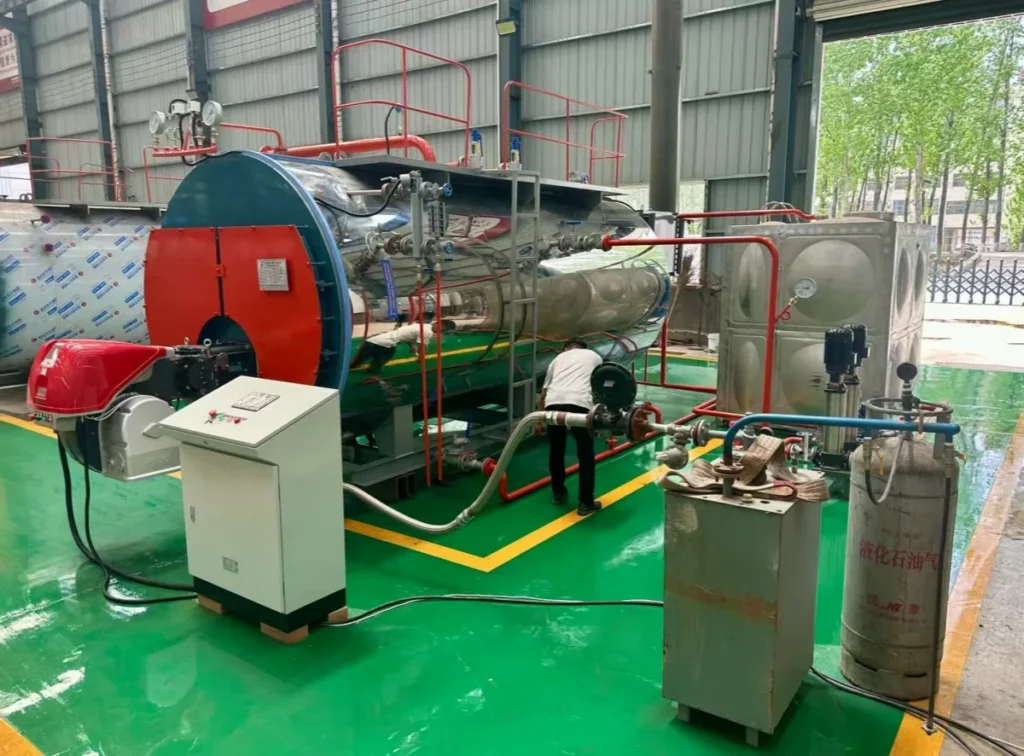
Anton Boiler provides different oil and gas boiler configurations for industrial steam projects, including WNS horizontal fire-tube steam boiler systems. Final capacity, pressure, fuel and auxiliary-equipment configuration must be confirmed for each project.
Coal and Biomass Steam Boilers
Coal or biomass may be considered where suitable solid fuel is consistently available and local regulations permit its use.
A fuel name such as “biomass” is not a complete specification. Send the supplier a representative fuel analysis showing the fuel type, particle size, moisture, ash and calorific value.
The combustion system, grate, fuel feeding equipment, furnace, fans, ash-removal system and dust collector must be matched to the actual fuel characteristics.
Electric steam boilers avoid on-site combustion and fuel storage, but they require adequate electrical infrastructure.
Confirm the voltage, frequency, phase, transformer capacity, local electricity price and peak-demand charges before selection.
Electric boilers may suit certain clean, smaller or intermittent steam applications. Their operating economics must be calculated using the factory’s actual electricity tariff.
5. Compare Fuel and Lifecycle Cost
The lowest fuel price per kilogram, cubic metre or kilowatt-hour does not automatically produce the lowest steam cost.
A preliminary comparison should consider the delivered fuel cost, fuel energy content and verified system efficiency.
The lifecycle-cost review should also include:
• Fuel transportation and storage
• Electricity for pumps, fans and fuel-handling equipment
• Water and water-treatment chemicals
• Blowdown and heat losses
• Ash disposal and emission-control consumables
• Operator labor
• Planned maintenance and spare parts
When comparing efficiency claims, ask the supplier to state the test standard, fuel basis, operating load and included heat-recovery equipment. Two headline efficiency percentages may not be directly comparable if they use different calculation conditions.
6. Check Feedwater Quality and Condensate Return
Water treatment is not an optional accessory. Feedwater chemistry affects scale formation, corrosion, blowdown, heat transfer, steam quality and equipment life.
Before final selection, provide a recent water analysis. Useful information may include hardness, pH, total dissolved solids, alkalinity, silica, chlorides and dissolved oxygen.
Also confirm:
• Expected condensate return
• Condensate temperature and cleanliness
• Make-up water source
• Daily operating hours
• Existing water-treatment equipment
• Boiler blowdown arrangement
Ask the supplier to specify the proposed water-treatment system and the required inlet-water conditions. Do not assume that one standard water softener is suitable for every boiler pressure or water source.
7. Confirm Emission Rules, Boiler Codes and Documentation
Emission requirements vary by country, city, fuel and boiler size. They may regulate nitrogen oxides, sulfur dioxide, particulate matter, carbon monoxide and other pollutants.
Before requesting a quotation, confirm:
• Installation country and city
• Fuel specification
• Applicable local emission limits
• Required dust collector, scrubber or other control equipment
• Environmental permit and testing requirements
The buyer should also identify the required boiler construction code, third-party inspection, material documents, welding records, pressure testing, registration and operator-licensing requirements.
Never assume that one certificate automatically satisfies another country’s statutory requirements.
8. Review Boiler-Room and Site Conditions
A technically suitable boiler can still become difficult to install if the site information is incomplete.
Provide the following information:
• Boiler-room length, width and clear height
• Door and access dimensions
• Foundation conditions
• Distance to the steam users
• Chimney location and height restrictions
• Fuel-storage area
• Water supply and drainage
• Ambient temperature and altitude
• Indoor or outdoor installation
• Available voltage, frequency and phase
For export projects, also confirm the destination port, inland transportation limits and lifting conditions.
A marked site drawing, photos and a short video are more useful than a general statement such as “the space is sufficient.”
9. Define the Operating Pattern and Control Requirements
The boiler control system should match how the factory actually operates.
Clarify:
• Operating hours per day
• Operating days per year
• Continuous or batch production
• Number of operators per shift
• Expected load changes
• Required automatic or manual operation
• Remote monitoring or communication requirements
• Need for standby capacity
Ask the supplier to explain the control philosophy, safety interlocks and the boundary between the boiler controls and the factory’s control system.
10. Compare the Complete Scope of Supply
Two quotations can show the same boiler capacity but include very different equipment. Always request a detailed scope list.
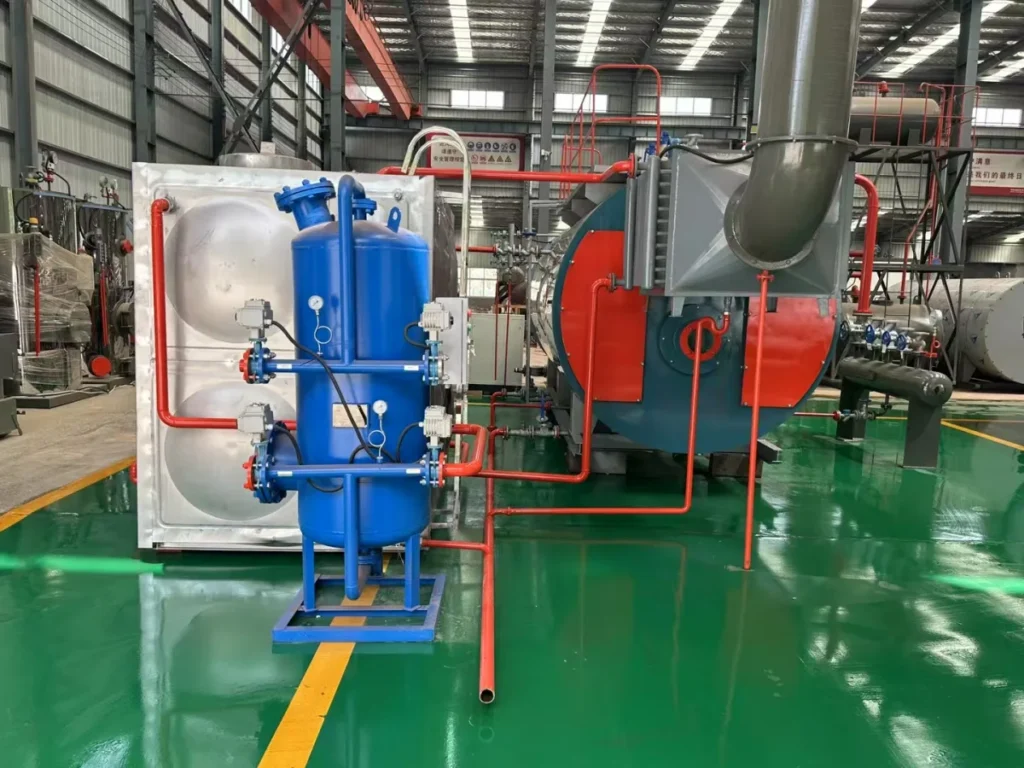
A complete industrial steam boiler system may include:
• Boiler body
• Burner or solid-fuel combustion system
• Feedwater pump
• Water-treatment equipment
• Feedwater tank or deaeration equipment
• Control cabinet
• Safety valves, gauges and instruments
• Economizer
• Fans and flue-gas ducts
• Fuel feeding and ash-removal equipment
• Dust collector or scrubber
• Chimney
• Valves and fittings
• Platforms and ladders
• Recommended spare parts
• Technical documents and operating manuals
Mark every item as included, optional, supplied by the buyer or not applicable. Also confirm the responsibilities for installation, commissioning, operator training, local labor, civil works and site piping.
11. Common Industrial Steam Boiler Selection Mistakes
1. Selecting by purchase price alone
A low boiler-body price may exclude the burner, water treatment, controls, emission equipment or essential valves.
2. Using fuel names without fuel analysis
“Biomass,” “coal,” “diesel” and “gas” are not complete fuel specifications.
3. Guessing the steam capacity
An unsupported capacity estimate can lead to oversizing or insufficient steam supply.
4. Ignoring the minimum operating load
A boiler selected only for the highest peak may operate poorly during long low-load periods.
5. Treating water treatment as an optional accessory
Water quality should be considered from the beginning of the system design.
6. Confirming boiler codes after ordering
Required codes and inspection requirements may affect the manufacturer, design, price and delivery plan.
7. Accepting unclear efficiency claims
Always ask for the efficiency calculation basis, fuel condition, operating load and included heat-recovery equipment.
12. Information Needed for a Boiler Quotation
Prepare the following information before contacting a boiler supplier:
• Application industry and production process
• Normal, peak and minimum steam demand in kg/h or t/h
• Required process pressure
• Saturated or superheated steam requirement
• Daily operating hours and load changes
• Available fuel and fuel analysis
• Raw-water analysis and condensate-return information
• Local emission limits
• Required boiler code and inspection
• Installation country and boiler-room dimensions
• Voltage, frequency and phase
• Required auxiliary equipment
• Destination port and inland transportation conditions
• Required delivery schedule
The more complete this information is, the more accurately a supplier can select the boiler, auxiliary equipment and commercial scope.
Frequently Asked Questions
How do I choose the correct industrial steam boiler capacity?
Calculate the maximum steam demand that can occur simultaneously, then review the normal load, minimum load, startup demand, verified distribution losses and approved future expansion. Do not choose the capacity from daily steam consumption alone.
Which fuel is best for an industrial steam boiler?
There is no universal best fuel. Compare local availability, delivered energy cost, storage, fuel quality, emission limits, operating labor and required auxiliary equipment before making the final decision.
Should I choose one large boiler or two smaller boilers?
Two boilers may provide better low-load matching, staged operation and maintenance redundancy, while one boiler may reduce the initial equipment count. The decision should be based on the actual load curve, availability requirement, space and budget.
What pressure should an industrial steam boiler produce?
Start with the pressure required at the process equipment. Then calculate the pressure losses through the distribution system and confirm suitable boiler operating and design conditions according to the applicable boiler code.
Why is water analysis needed before boiler selection?
Raw-water hardness, dissolved solids, alkalinity, silica and dissolved gases can influence scale, corrosion, blowdown and water-treatment selection. A recent water analysis allows the treatment system to be selected for the actual project.
What should be included in an industrial boiler quotation?
A clear quotation should identify the boiler design conditions, fuel assumptions, efficiency basis, auxiliary equipment, water treatment, emission equipment, documentation, inspection, delivery terms, installation boundary, commissioning support, exclusions and recommended spare parts.
Conclusion: Choose the Boiler as a Complete Steam System
Learning how to choose an industrial steam boiler means looking beyond the boiler nameplate.
The right selection connects the factory’s real steam demand with the required pressure, suitable fuel, water treatment, emissions compliance, site conditions, controls and complete auxiliary system.
Before comparing prices, prepare a clear process-load schedule and project-data sheet. Ask each supplier to quote against the same technical requirements and supply boundary. This makes technical and commercial differences easier to identify.
Request an Industrial Steam Boiler Selection
Anton Boiler can review your factory’s operating conditions and prepare a project-specific boiler selection for technical discussion.
Please send your application, installation country, normal and peak steam demand, required pressure, fuel type, voltage, water analysis, local emission requirements and required supply scope.